Author: Christina Robert, PhD, LMFT

I am a marriage and family therapist and have been working in Family Law with Robert Family Services doing ADR, Custody Evaluations and Parenting Assessments in addition to therapy. I have my PhD in Family Social Science from the University of Minnesota and I am a Licensed Associate Marriage and Family Therapist. I have over fifteen years of clinical experience working with individuals, couples and families. My areas of expertise include assessment of children, child development, co-parenting, immigrant communities, Autism Spectrum Disorder, and ADR. I am a Qualified Neutral under Rule 114 of the Minnesota General Rules of Practice. I practice in Roseville, MN at www.robertfamilyservices.com.

Teaching Toddlers Values: The Creation of a Person

I’ve recently come to realize that parenting a toddler is a full time job, and not just in the tedious, labor intensive way that building a house or plowing snow is.

It’s about something much more critical to the long-term well being of our children. It’s about the oh-so-important job of creating a person.

CREATING A PERSON?

Yes, creating a person—a person that we as parents can be proud of. A person that is steal, lie or cheat in order to get their basic needs met. It’s about creating a person who can move through the world with ease and with dignity. It’s about creating a person who knows right from wrong and acts according and about creating a person who gives and receives love and charity easily and with grace.

And it takes every second of every single minute that you’re with this little being-in-the-making.

There is no time for a break, no time to relax. If you stop to breathe for a moment you will miss a teachable moment.

Now, don’t get me wrong. I like to relax and I don’t think I go toooverboard on the whole parenting business. It’s just that these little free-spirited toddlers that know no impulse control and are running around like little savages don’t give you the opportunity to take a moment to rest and to breathe.

When they smack the dog in the head you are forced to take the opportunity to teach the value of kindness and gentleness towards others. When they march into the Director’s office of the daycare and say “I have sticker?” you have to teach them the value of good manners. “Say ‘por favor’! Say ‘gracias’! Say ‘adios’!” (My daughter actually goes to an amazing daycare where the staff are all native Spanish speakers and they speak Spanish all day to the children.)

Here’s a short list of some of the values I’ve identified as ones that I subconsciously and consciously have been trying to teach my toddler:

1. Expressing and Exuding Kindness of Spirit

I want my child to be a warm and good person. I want her to show her friends that she loves them and appreciates them. I want her to be kind and friendly to people she knows and to strangers she meets in the street. I encourage her to approach people and when she spontaneously smiles and engages in conversation with strangers, I facilitate the conversation whether the person on the receiving end is interested or not. I don’t want to squelch the natural social behaviors that I see coming from her on a daily basis.

2. Sharing

Every toddler needs to learn how to share and aren’t we given the daily opportunity to encourage that? I feel very fortunate that my child loves to share with her peers even when she is not asked to. Mostly this comes in the form of food. I have to ask myself if she is imitating me (given that 99% of what she does is mimicking my behavior), and if I think about it, she may certainly be doing so. I love to cook and I always offer some of what I have made to everyone around me.

3. Generosity

Similar to sharing. I want her to be generous to others and to share her belongings or her food or her toys. Generosity is a value that was instilled in me and I want to instill that in her as well. I want her to give and give freely. I want her to enjoy the warm feelings one gets from sharing and giving to others.

4. Expressing Love

I want my child to be warm, to give hugs, to show her friends and family that she likes and loves them.

5. Connecting with Others in a Meaningful Way

I want my daughter to develop meaningful relationships. I want her to greet others when she sees them after they’ve been gone and to say hello and good-bye and good-night to show that she cares about the presence they play in her life. It would be easy enough for her to not greet her peers and to just start playing but I make a point of having her go up to her friends and to say hello, to have her hold hands with them, to have her appreciate their friendship.

6. Engaging in Good Manners and Appropriate Social Behavior

Of course she needs to engage in the standard social niceties: Please, thank you, you’re welcome, hello, good-bye. No hitting, shoving, biting, etc.

7. Patience

This is a hard one to teach a toddler as they like to push the limits and to act as if nothing short of immediate gratification is acceptable. I deliberately use the word “patience” with her while she is waiting for something. I sit by her side and hold her close to me. “We need to be patient,” I tell her. “It’s hard, I know. Sometimes we need to wait. That is being patient.” I am trying to teach her the concept of patience rather than just the behavior of needing to wait. I think it will have more value in the long run this way.

8. Turn-taking

Turn-taking is about recognizing and understanding that there are other people in the world besides herself. As a concept and a behavior it goes beyond playing games or using the playground equipment. It is the understanding that we have our own needs but that we need to watch for and meet the needs of others, even if they do not ask us to.

9. Understanding and Acceptance of Diversity

This is harder to teach to toddlers but when she asks me questions about people who look different from her I explain the difference in a way that is factual, accepting and open, without secrets. I help her to understand what makes people different from each other.

10. To Love, Respect and Appreciate Nature

How could I forget this? In some ways it is the most important value in a technology-laden , eyes-glued-to-the-screen age. Because of an ever-increasing dependence on electronics, it is imperative that we teach our youngsters that the world is bigger than they are, that getting dirty is okay, and that food comes from the earth. Giving them the opportunity to feel leaves crunch under their feet, rain falling on their faces and dirt in their hands, are all ways we engage in the enormous job of teaching them to love and appreciate the earth and the world we live in.

How do you teach these values to little people?

Well, I’ve examined how my time is spent engaging in this ongoing task of facilitating the development of one (hopefully) amazing human being and this is what I’ve come up with…

  1. One of the ways is to model the behavior or action for her. Saying please to her; saying thank you to her; showing her how her momma does it. I read somewhere that this is actually more effective than continually reminding them of how to behave.
  2. Another way is reinforcing her positive behaviors. Anytime a “positive” behavior is produced you praise the heck out of them. If she spontaneously shares or offers a cookie to a friend, “That was wonderful! What a nice job you did sharing! You are sooo sweet!” Watch the happy look that comes over their face. They feel good having pleased you and are likely to repeat the behavior simply because of the praise they received.
  3. A third way is correcting negative behaviors. “We don’t hit when we’re angry. We say, ‘That makes me mad.” In addition to pointing out what they did wrong, and even more importantly, is to tell them what TO DO rather than what not to do. This can be very helpful when you’re in the moment. If your child is reaching out to hit, you can catch the hand and say… “No, no…we don’t hit to get what we want. We ask for what we need. Can you ask your friend for the ball?” Telling them what to do gives them a behavior they can act on rather than just feeling reprimanded or punished.

Well, those are my thoughts on teaching toddlers values. Interestingly, these are probably the values that will continue on as my child ages and develops. So, in essence, as parents we are creating the core values that our children will carry forth with them for the rest of their lives. It’s an amazing time in their development as they are soaking up everything like little sponges and imitating every little thing we do. This is the prime time for developing all of those pro-social behaviors that we want to see in our children. In essence, we’re in the throes of helping to create the people we want our children to be in ten and twenty years. It’s a big job – bigger than I ever imagined – but one that I signed up to do and one that I do not take lightly!

Multi-Media Painting for Toddlers and Children Alike!

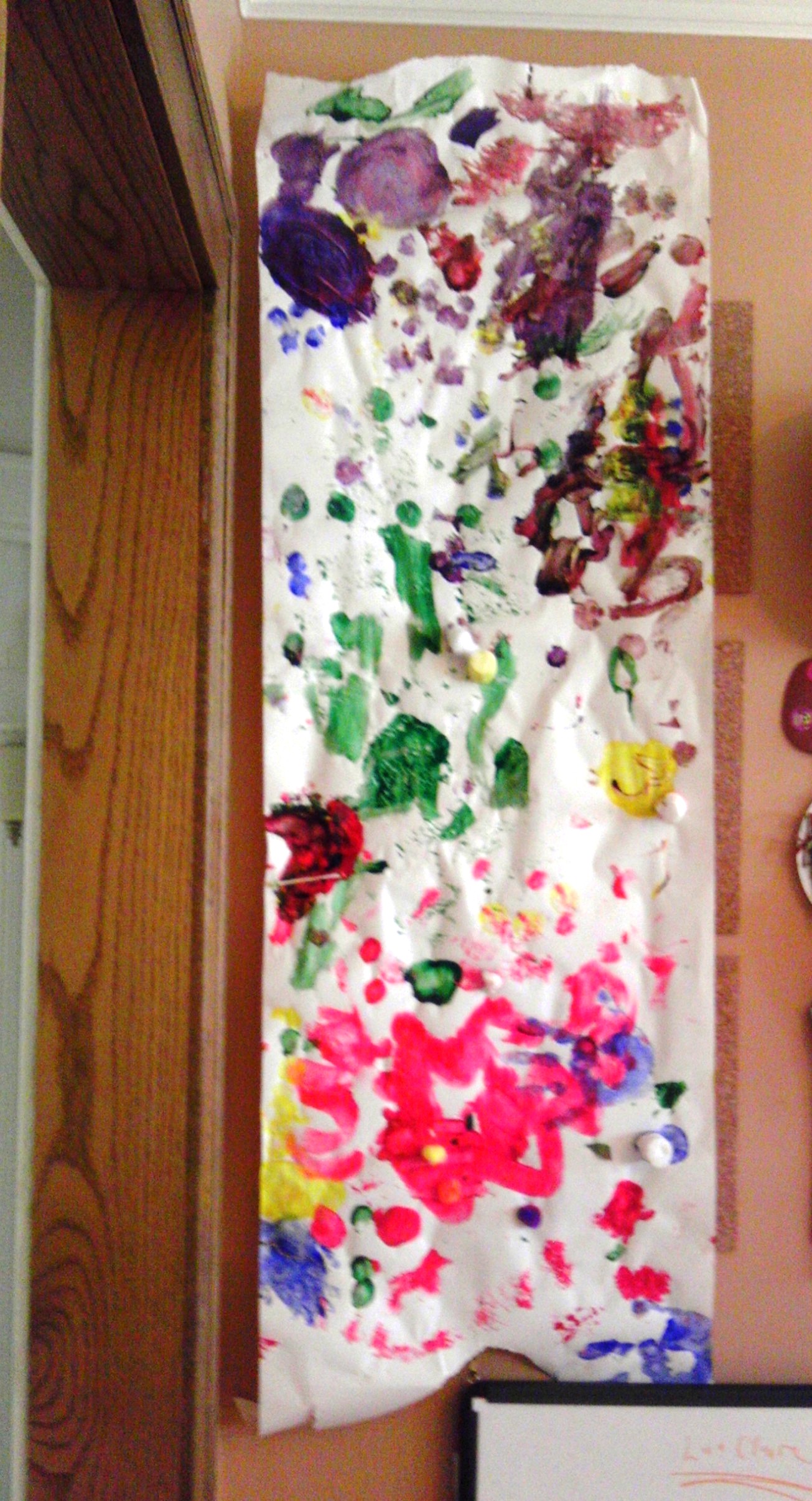
It was time to cook dinner and I needed an activity for my three year old and an adult friend I had over. Fingerpaints, I thought! It was something I’d been wanting to do but hadn’t had the time to explore fully. I pulled out the easel paper, a thin waterproof drop cloth that I keep on hand for messy occasions (I think I picked it up at the dollar store or a local drugstore. It was cheap but seemed like it might come in handy some day), and the paints.

In addition to the paints, I decided to add in some multi-media materials to make it interesting.

I brought out the following:

A set of paint brushes
A bag of cotton balls
Q-tips
Colored pom-poms
Marshmallows (an Inspiration Laboraties idea, I believe)
Leaves and evergreen branches from outside

Off we went! I’m not sure if I even got to dinner given that the painting project was so much fun, but I’m guessing I did. My daughter LOVED this activity and was engaged and happy for a good 30 minutes, as I recall. We stopped when the paper was pretty much lacking in space.

I used the lid to the paint box as a palette.

She had a fun time stamping with the marshmallows and then sticking them in the paint. The marshmallows, the cotton balls and the pom-poms all served as both something to paint with as well as part of the finished product.

It was an awesome project and the full painting is hanging on the dining room wall for all to see. Since that day, “Momma, I wanna paint!” has been heard pretty frequently as well.

Full picture hanging on the cork board.

Related Posts:
Painting with Spices
Oatmeal Playdough

Bringing new mothers’ pain out of the shadows

More needs to be done to raise awareness about the devastation of postpartum depression among the public and medical community and to make effective treatment widely available.

Kimberly Wong

Public defender Kimberly Wong, who suffered severe postpartum depression, founded the Los Angeles County Perinatal Mental Health Task Force to raise awareness about the illness. (Christina House, For The Times / July 29, 2012)

By Kurt StreeterJuly 29, 2012 

Just like for so many others, including my wife, Kimberly Wong didn’t see the darkness coming, and nobody warned her that it could.

Here’s what happened. After years of trying, Wong got pregnant and at first everything went perfectly. The lead-up, the birth, the first week with the new baby, a cute little girl she and her husband named Marley.

Then out of nowhere this tough-minded public defender crumbled. Wong’s skin felt like it was being zapped by a cattle prod. Her resting heart rate was often 100. She could barely eat, sleep, slow down or think cogent thoughts.

Her doctor told her she was simply a high-strung lawyer who needed to relax. So she blamed herself, which made matters worse.

It didn’t help that the doctor’s advice made no sense. Wong had something relaxation can’t cure. She’d been hit by postpartum depression, brought on by, more than anything else, whipsaw hormonal changes that come with giving birth.

This isn’t something we can afford to keep sweeping into the shadows.

Experts say 10% to 20% of new mothers experience it: a steep drop in mood that’s far more devastating and lasts far longer than two or three weeks of the so-called baby blues.

Wong had the worst type. She penned a suicide note. By luck, her husband walked in on her. He took her to a Mid-City mental hospital so she wouldn’t harm herself. Nobody at the hospital had much expertise in what she was battling.

That’s when Wong realized how few options there are for women who need psychological help related specifically to motherhood. She had to drive 50 miles to find a doctor and a support group that really understood.

You should know that time has passed, about eight years since the height of it, and Wong and her family have bounced back. In fact, she has turned her struggles into something good.

“I’m trying to make sure other moms don’t go through what I did,” she says.

When she’s not working at the public defender’s office, she focuses on the nonprofit she started: the Los Angeles County Perinatal Mental Health Task Force. Sure, clunky name, but can there be a more important cause?

Experts say that in L.A. County alone, about 22,000 new mothers suffer from this awful malady every year.That’s 22,000 women — as well as their babies and partners — who need special support and too often aren’t getting it.

The task force — bare bones, operating largely on the energy of volunteers — aims to push us out of the shadows: moms and families who need help but are too embarrassed or just don’t know where to turn; doctors and social workers who are either ill-informed on the nuances of this illness or just don’t look hard enough for the warning signs.

Wong’s doctors didn’t really talk about the possibility she could grow terribly depressed after giving birth, she said. They should have.

She’d suffered childhood trauma: Her mother died when Wong was 11. There was a history of mental illness in her family, and she’d struggled to conceive. Those three facts put her at risk, but no doctors warned her, nobody came up with a plan that could have shielded her from near-fatal darkness.

“There’s just so much stigma that needs to be shattered,” Wong says. “I want people to talk about this like they talk about diabetes or having a bad heart. Not enough has changed since this happened and when it did happen I could barely get help.

“I’m a professional from West L.A. and it was hard enough for me,” she adds. “So think about women in poor communities with little access to good healthcare. Add it up and so many are suffering and the long-term effects for families can be devastating. Yeah, we need to talk.”

I know.

After the birth of our son in 2010, my wife battled postpartum depression. It wasn’t anywhere nearly as serious as what Wong went through and that’s important to know: This malady shows up in different strengths.

My wife’s was a more typical case. She wasn’t close to hurting herself or being put in a hospital. She did everything anyone could ask for our son. But for long, long months she lived in a world of sharp, shattering emotion that could have been avoided if we’d known more or had more aggressive help.

It could have broken my wife. What if she hadn’t had a partner to help? What if she had been poor? We’re insured, and even then it took a while for her doctors to understand how serious this was. But eventually she found a therapist who could talk her through the trouble.

Part of the problem is we live in a world swaddled in golden-hued mythology about parenthood. It’s supposed to be full of nothing but joy. If it isn’t, then moms are told to get more sleep and toughen up. That’s not helpful when depression sinks in its claws.

“A lot of us hide from this issue,” says Wong. “That has to change.”

She’s talking. So am I. So is my wife, who pushed me to write about her ordeal. If you care about mothers and children and families, well, you should be talking too.

kurt.streeter@latimes.com

Copyright © 2012, Los Angeles Times

Extended Bottlefeeding and Obesity

Does Extended Bottle-Feeding Really Cause Obesity?

July 20, 2012
 
 
****************************************************************************************************
 
With research you have to remember that it’s not every single person that will have the outcome that they predict. What the researchers are saying is that for those babies that drank out of a bottle longer, more of the babies were likely to be obese later on. This not a direct cause and effect, meaning that it does not mean your baby will be obese if she is still using the bottle at 36 months. I have a child who is a perfect example of that. Three years, two months old, loves the bottle, skinny as a rail. But there is something to the research and the underlying reasons are what need to be examined. Are the babies who drink from a bottle as an older child also getting sugary cereals and breakfast bars instead of fruits and vegetables? This are things to examine and look at.
 
Christina

*************************************************************************

The following is reposted from:

Even though she’s now 23 months old, my daughter Maya still really likes hitting the bottle. It’s a ritual—the first bottle of the morning, and a request when I get home from work. She sits on my lap, we cuddle, and she relaxes, her body growing less tense. In the evenings, I don’t give her much because it will ruin her dinner. We both know it’s the pose that matters, and that little time for reconnection.

So of course I was immediately concerned when my pediatrician abruptly told me to stop using bottles “cold turkey” because they are linked to obesity. She was right that a new study from last year connected bottle usage to obesity, and it sure made for some frightening headlines when published, like this one: “To Avoid Adult Obesity Stop Bottle-Feeding at 18 Months,” from Medical News Today. The article began by intoning darkly:

If you want to reduce your baby’s chances of becoming an obese adult you should not continue bottle-feeding him/her beyond 12 to 18 months.

Who wants a fat kid, really? Or this one, from U.S. News, “Prolonged Bottle Feeding Boosts Kids’ Obesity Risk,” which began:

Nearly one-quarter of 2-year-old bottle feeders were obese at age 5, researchers say.

Well, I suppose that seems clear enough. But what did the research really say? Here’s more detail:
The prevalence of obesity at 5.5 years was 17.6, and 22.3 of children were using a bottle at 24 months. The prevalence of obesity at 5.5 years was 22.9% (95% CI, 19.4% to 26.4) in children who at 24 months were using a bottle and was 16.1 (95% CI, 14.9% to 17.3%) in children who were not.

Prolonged bottle use was associated with an increased risk of obesity at 5.5 after controlling for potential confounding variables (sociodemographic characteristics, maternal obesity, maternal smoking, breastfeeding, age of introduction of solid foods, screen-viewing time, and the child’s weight status at birth and at 9 months of age).

I was struck by several things here. First, although nearly 23 percent of bottle-feeders were obese at the age of 5 1/2, 16 percent of the rest of the population (i.e., not bottle users) also were, which is only a 7-point difference.

Second, the sample size is on the small side — i.e., 22 percent of the sample used a bottle, 23 percent of whom ended up overweight. That’s a total of 341 kids. If we subtract the 16 percent that represents the background obesity rate, there are only 55 kids whose habits are driving the conclusions (because they make up that 7-percent spread). The authors say that is a statistically significant number, though, so I also took a gander at their assumptions.

They used a data set with limited inputs, certainly. First, the study did not account for what was actually in the bottles. Yet it seems to me that this could matter a lot. Apple juice, for example, is high in calories and does not fill you up, yet creates a taste for sugary drinks, making it easy to consume to excess. While whole milk may be higher in calories, it offers a host of essential fats, vitamins and calcium, and is denser and harder to over-consume. Water, obviously, has no calories. Formula, which is loaded with sugars that stimulate appetite, unsurprisingly is also linked in previous studies to obesity.

As children are frequently given juices (or even worse, Kool-Aid), given the small number of families driving the conclusions, this seems like an important caveat, and one notably missing from the official conclusion or coverage. Instead, the authors publicly suggest the opposite, where one of them claims that the study accounted for “feeding practices during infancy.” But this is misleading. After all, what a child is actually consuming has just got to be more important than whether it’s being delivered by bottle or cup.

Second, the study did not measure the kind of bottle being used, whether glass or plastic. Before you think I’ve gone off the deep-end on this one, consider that studies have shown that Bisphenol-A (BPA) likely plays a significant role in obesity, both by making our bodies produce insulin as though we are consuming twice the calories we actually are, and by helping to flip a genetic switch that predisposes us to be fat.

The study’s data-set spans 2001 to 2006, when most parents were unaware of the BPA issue and most bottles still had BPA in them, and in which plastic bottles were typical, as they are today. But the analysis simply ignores the possibility of harmful chemical influences.

Third, the authors’ don’t recognize any benefit at all from using a bottle:

Rachel Gooze notes that weaning children from the bottle by the time they are 1 year of age is unlikely to cause harm and may prevent obesity.

I beg to differ. Research shows that strong bonding is essential to healthy brain development, particularly in children ages 0 to 3 years. While extended use of a bottle is not an essential part of creating these bonds, the act of feeding a child is intrinsically a nurturing moment, and so it may not be irrelevant either. The researchers should have at least considered the possible emotional downsides.

For our family, my daughter never breastfed, and so our bonding over a bottle has replaced a rather fundamental missing piece. I’m not eager to let this go based on one study showing she could, maybe, have a slightly greater chance of being obese four years from now, especially given the care I take with her overall diet. For example, she almost never has juice, or really concentrated sugar of any kind.

If using a bottle appeared to be causing cavities or hampering her speech development, that would be another issue, and is a legitimate concern raised by dentists (those sugary beverages again!) and speech pathologists. My daughter now uses (I would guess) about 600 words and more every day. She’s also never been very interested in a pacifier or thumb-sucking, either of which can also be a speech development blocker.

Moreover, she eats a wide variety of fruits, proteins and vegetables, uses both sippy cups and regular cups, and is learning to use a straw, as speech experts advise. The bottle is just a break, and I assume will drop away sometime when she’s no longer needs that daily form of checking in. If not, we’ll ease it out of use and replace it with some other bonding ritual we invent.

In the end, I’m not convinced at all by this study, and disappointed that both my pediatrician and the press apparently take its conclusions as gospel. Advice from doctors rarely seems to take account of the havoc that would be wreaked on families’ lives by following their rigid approach. The costs of this in terms of both family peace and pediatric credibility are high. And the concerns around obesity have now reached such a fever pitch that it seems we’re able to be bossed around on “slim” evidence indeed.

In the end, it seems to me, we all would benefit from trusting our instincts about what’s right for our child–for others besides my daughter, taking the bottle out of circulation may be no big deal. For the rest of us, we probably just need a moment or two to relax in a day, and so do our kids.

How does your family come down on this issue? Am I just making up excuses because I don’t want to face the music (or really, screaming)?

Did I miss something important about the study or its implications? Or do you agree with me that this is just another in a too-long line of simplistic anti-obesity messages that fail to grapple with the real issues?

Laura MacCleery is a non-profit lawyer, mom and squeaky wheel in search of a spoke. Read more of Laura’s writing on her blog, Laura’s ‘Rules’.

Doctors, Choices, Homebirths

The Ties that Bind: How Belief Creates Birth Realities
 

http://www.midwiferytoday.com/articles/ties.asp

© 2003 by Kim Wildner. All rights reserved.

[Editor’s note: This article first appeared in Midwifery Today Issue 68, Winter 2003.]

There is a story told of a baby elephant in Tibet (1) tied about the ankle with a rope. The rope would not hold an adult elephant, but it holds the baby tight even as it struggles to free itself. The baby resigns itself to the fact that it cannot move outside of the parameters of the rope, no matter how hard it tries.

Eventually, the elephant reaches adulthood, the same little rope about his ankle. Now, little effort would be required to snap the rope and walk away, but the elephant doesn’t even bother to try. He is bound only by his belief that he is unable to escape, which is just as effective as his captors.

Women giving birth today have more options than ever before, yet perceive very few. Information is available in unprecedented quantities at the touch of a fingertip, yet erroneous beliefs impact decision-making more than cold, hard facts.

Women believe that birth is a dangerous medical event. The fact is that normal birth is safer than many things we do each day without a thought (2).

Women believe that U.S. technology makes birth safe. The fact is that birth is much safer in countries where technology is more appropriately utilized (3).

Worse yet, women are often not making decisions at all. Like the elephant that cannot conceive that he has the power to walk away, women simply do not see the options before them.

A mother called me regarding private childbirth classes. During the course of the discussion, she explained that she wasn’t even sure the classes would help her, as she was planning a VBAC (vaginal birth after cesarean) and doubted it would “work.” Further discussion revealed that her doctor was insisting on certain “conditions” in order to “attempt” this VBAC.

  • The mother would be induced if she went “over due,” as determined by an ultrasound (4).
  • The mother would be induced if her baby got “too big,” as determined by an ultrasound estimation (5).
  • The mother must deliver between 7:00 a.m. and 5:00 p.m. when an anesthesiologist would be on hand. If that looked unlikely, induction or augmentation would be required. If she did not dilate steadily and quickly she would be augmented with Pitocin or Cytotec. If she were still laboring near the end of her given time frame, surgery would be inevitable (6).
  • The mother must labor with an epidural (7).

The reason for these restrictions was that the American College of Obstetricians and Gynecologists (ACOG) had issued new “guidelines” for VBAC, supposedly from a study that “proved” VBAC was unsafe (8).

However, what the study showed was that “obstetrically managed VBAC” was unsafe. The factors that made VBAC unsafe were mainly—hold on to your seat—pharmaceutical induction agents that are known to cause uterine rupture in non-scarred uteri (9). In other words, any woman in labor who gets them, not just VBAC mothers. Instead of investigating the drugs, which are not FDA-approved for nonmedical indications, the recommendation became to put restrictions on VBAC that bring about the very conditions that are singular to the drug/VBAC combination, not the VBAC itself. That “logic” is just lost on me, but it’s beside the point, anyway.

The story of the elephant mentioned above doesn’t parallel the illogic of ACOG; it parallels the thinking of the mother who contacted me. She was quite distraught that she probably wouldn’t be able to meet all of the conditions set by the doctor. She was right. She had as much control over them as she has over the tides, the moon or the sun.

She asked me if I thought she had a bad doctor. She asked me what I thought about the hospital policies. She asked me if she should change hospitals or doctors. None of this is my call to make, even if I knew her or her doctor, which I didn’t. I told her I thought she had some tough decisions to make. As a childbirth educator, I could provide her with the information she needed to weigh in order to make a sound decision, which I did. I gave her several book recommendations and links to studies showing the conditions she was being asked to meet were not only impossible, but flew in the face of science and plain old common sense.

I reminded her that the criteria for making sound decisions must include determining if the choice she was being asked to make was based on facts (it wasn’t), if it was in her and her baby’s best interest (it wasn’t) or if it would improve her experience (it wouldn’t) (10).

I heard from her again at a later date. She had read some of the material and she was getting anxious about her predicament because she didn’t feel she had any options. She ended her communication with the thought that she would probably just go with whatever her doctor wanted because, “What choice do I have?”

She didn’t believe she had options, so she didn’t have any. Perception is reality. While I refused to make her decisions for her, I felt I had given her enough information to broaden her options.

She could:

  • Present scientific references that challenge her doctor’s conditions and request that he provide evidence to support his stance.
  • Request that the hospital base its policies on the safety of her and her baby instead of concern over its liability.
  • If either or both refuse, find a doctor who did practice evidence-based care.
  • If one could not be found in her area she could
    • Choose a homebirth midwife;
    • Choose the nearest freestanding birthing center;
    • Choose a hospital/doctor in a neighboring county;
    • Choose to go out of state to somewhere like The Farm in Tennessee, where she could stay and safely birth her baby.

Granted, not all of these are easy choices to make, but other mothers have made them. It is not only the right, but also the responsibility, of women to ensure that the options they are offered are safe and in the best interest of their babies. If not, they need to seek new options. I’m sure there are others I haven’t thought of, but the point is she certainly not only had a choice, but several. The data I provided on evidence-based care and safe birth did nothing to illuminate this mother’s options because it wasn’t about facts, it was about belief.

In the last few months, I have received two other calls that illustrate this point just as well.

The first call came from a mother who had talked about hiring a midwife for her second birth because of her disappointing first birth. The first time around, she had done beautifully with HypnoBirthing® for most of the birth. Her caregivers had raised several red flags, however, during the course of her pregnancy, giving her warning that they would say what she wanted, then do what they wanted. Still, for some reason she thought it would be different for her. (There seems to be a common belief among pregnant women that somehow they will magically be able to change their caregivers when others have failed.)

Predictably, at the very end, the caregivers did what they promised they wouldn’t: they coached her to “purple push”—that horrid, harmful purple-faced pushing seen on those awful birthing shows. Amidst the yelling and counting, she couldn’t stay focused on “breathing the baby down,” not to mention the fact that she was afraid for her baby. They had promised they would only do this if it were necessary “for the sake of the baby.” The baby was never in peril. The mother (predictably) tore badly, which meant her early months of mothering were consumed with physical and emotional pain. Energy that should have gone to her child was wasted on trying to heal a relationship that struggled through the stress of a sexless existence.

In the years it took her to recuperate from this betrayal, she insisted she would have a homebirth with a midwife for the next baby. However, once she actually got pregnant, she went to an in-hospital birthing center, which started right away with routine ultrasounds scheduled at eight, 12 and 20 weeks. Knowing the suspected risks of ultrasound, this made her uncomfortable, but she was staying with the center because she said, “I have no choice. My insurance doesn’t cover homebirth.” Even if changing providers was impossible—though I believe nothing is impossible with enough determination—she still had choices. She could refuse the routine technology and let it be known that if there was a legitimate medical indication that could be substantiated (they had given her a “medical” reason for the intervention that, with a little research, was shown to be nonsense), she would surely cooperate for the sake of her baby.

Her insurance didn’t cover homebirth. That’s because it didn’t originate to help people get better care; it originated to help doctors get paid. Regardless, the co-pay for her hospital birth-center birth was about the same as what a homebirth midwife charges. If this woman ends up having surgery, the co-pay will be much more, not to mention the ripple effect of what it will cost during her recovery and in subsequent births, and the emotional toll.

She believed she had no choice, so she had no choice. Perception is reality.

The second call that illustrates this idea came from a woman who commissioned me to do some birth art for her. During the time I spent with the woman, she expressed anxiety about the fact that her doctor was starting to talk induction. She had read about the dangers of nonmedically indicated induction and wanted to avoid it “at all costs.”

She was a healthy woman with a healthy baby, two weeks away from her estimated delivery date, which could be as much as four weeks from actually delivering. She enjoyed being pregnant and had a lovely support system in her husband and family. Her doctor’s only reasoning behind mentioning induction was that she “looked about ready.”

This mother’s vehemence in her insistence that she wanted to avoid this intervention was impressive, but it didn’t translate into action. When I asked what she was going to do to avoid the induction, she replied, “I guess I’ll just have to do it. I don’t really have a choice.”

Have you any idea how often these words pass over an expectant mother’s lips?

Women always have a choice. The question is not whether they have a choice, but are they willing to make a choice. Changing a belief system, especially one that’s held collectively, like ideas about birth in the U.S., is a subject too complex for one article. I spend a great deal of time discussing how to identify our faulty assumptions so that we may make better birthing decisions in my book, Mother’s Intention: How Belief Shapes Birth (August 2003).

Even if a woman doesn’t instantly revise her beliefs about birth, the only factors that should have any importance are these: whether her choices are based on fact, if they are in her best interest and if they affect her experience positively or negatively. She need not concern herself with what is good for the hospital or doctor. Her only responsibility is to look out for the child, and by extension, herself.

<!– –>Kim Wildner is the author of Mother’s Intention: How Belief Shapes Birth (Harbor & Hill Publishing). She has been a childbirth professional for 12 years, holding certification with ALACE and the HypnoBirthing® Institute. She has one homeborn daughter.

Notes

  1. This universally understood story has many variations, with different locations and even different animals.
  2. Mortality statistics for motor vehicle accidents, heart disease, unintentional injury, cancer, HIV and other causes of death can be found at www.cdc.gov/nchs.
  3. The U.S. is rated 27th in the world for infant mortality and 13th in the world for maternal mortality (see www.savethechildren.org/mothers/report_2003/ for more information on the 2000 State of the World’s Mothers report).
  4. Ultrasound is only accurate to within two weeks on either side of an estimated due date. Only about 5 percent of babies are actually born on their “due date.” See www.birthsource.com/articlefile/Article86.html.
  5. Ultrasound is no more accurate than an educated guess at fetal weight. It is only accurate to within two pounds on either side of the actual weight. Considering that most obstetricians consider a normal eight-pound baby to be “too big,” if they induce because ultrasound estimates the baby is nearing eight pounds, the baby could really be only 5 lbs., 15 oz.
  6. See www.obgyn-wolfson.org.il/Content/Articles/ArticlePDF/AriclePDF655.pdf and www.midwiferytoday.com/enews/enews0326.asp.
  7. See www.childbirth.org/articles/episec.html.
  8. ACOG and other caregivers are now using a study found in the July 5, 2001 issue of the New England Journal of Medicine to suggest that VBAC is unsafe. See http://content.nejm.org/content/vol345/issue1/index.shtml.
  9. Visit www.hencigoer.com/articles and www.ican-online.org, where there are many articles that attest to the truth of this statement.
  10. Decision-making criteria adapted from Dr. Phil McGraw. See www.drphil.com/advice/advice.jhtml?contentId=1055_litmuslogic.xml.

References

  • Baum, J.D. et al. (2002, March). Clinical and Patient Estimation of Fetal Weight vs. Ultrasound Estimation. Journal of Reproductive Medicine 47 (3):194–98.
  • Lydon-Rochelle, M. et al. (2001, July 5). Risk of Uterine Rupture During Labor Among Women with a Prior Cesarean Delivery. New England Journal of Medicine 345 (1): 3–8.
  • U.S. Dept. of Health and Human Services. Maternal Child Health Bureau. (2001). Child Health USA 2001. Washington D.C.: Health Resources and Services, p. 22.

RELATED POSTS:
Everything You Need to Know About a Home Birth
Vaginal Birth After Cesarean – Make an Informed Choice

Recipes to Try

Other recipe posts

Peaches & Cream Cake

from Mel’s Kitchen Cafe

Cake:

Peaches and Topping:

  • 29-oz can sliced peaches or 1 quart home-bottled peaches Dole Coupons
  • 16 oz (2 packages) cream cheese, light or regular, softened to room temperature Cream Cheese Coupons
  • 1 cup granulated sugar
  • 6 tablespoons reserved peach juice
  • Cinnamon and sugar for sprinkling

Preheat the oven to 350 degrees. Lightly grease a 9×13-inch baking pan with cooking spray and set aside.

In a medium or large bowl, combine the flour, baking powder, salt, sugar and cornstarch. Blend. Make a well in the center and add the vanilla, eggs, milk and melted butter. Whisk together until well combined. Spread the batter evenly in the prepared pan.

Slice the peaches into bite-sized pieces, scattering them over the top of the batter evenly. In a medium bowl, beat the cream cheese, sugar and reserved peach juice together until light and creamy. Dollop the cream cheese mixture in tablespoon-sized spoonfuls over the top of the batter and peaches and then use a spatula to evenly spread together to form a creamy layer. It doesn’t have to be perfect, just try to spread it as evenly over the top as possible (it’s ok if peaches are peeking through in spots). Sprinkle the top of the cream cheese layer generously with cinnamon and sugar.

Bake for 45-60 minutes until the edges are puffed and golden and the cream cheese layer has bubbled slightly on top. This is a difficult cake to test for doneness because of the gooey cream cheese layer. If the middle is still jiggly, bake until it no longer jiggles and the cake batter layer is puffed and no longer runny. Serve warm or at room temperature.

************************************************************************************************************************************

Grated Carrot Salad

Grated carrot salad is a favorite dish for French kids. They eat it regularly for school lunch, and it’s popular at home as well. Even adults enjoy it as a starter. They more finely grated the carrots, the more the natural sweetness of the carrots will dominate the flavor of this dish. For kids who have a hard time with crunchier textures, this might just be the dish that convinces them they love carrots.

8 large carrots
2 tablespoons
olive oil
Juice of one orange
Juice of half a lemon
One bunch flat leaf parsley
Optional: a dash of Dijon mustard Pinch of salt
Dressing: Mix the orange and lemon juice with the olive oil and the salt.

You may want to add more oil, or lemon, depending on your tastes. But don’t overdress this salad! It should be nicely coated, but not swimming in the dressing.

Carrots: Peel the carrots. This is important, because the skin is often more bitter than the interior! Grate the carrots in fine shreds using a hand grater or machine. (These food mills are popular in France, and make fine, delicate shredded carrot—if you have one, use it!) The finer the strands, the more delicious the salad.

Parsley: Chop a quarter bunch of flat leaf parsley, in fine, small (I mean teeny, tiny) pieces. Make sure you don’t include any of the stems—just the leaves.

Note: You don’t want dried parsley, as the fresh parsley offsets the texture of the carrots perfectly, whereas dried parsley tends to taste a bit crunchier and, well, dry.

Combine the carrots, parsley, and dressing just before serving. Best served slightly chilled or at room temperature. Bon Appétit!

**********************************************************************

http://gogoquinoa.com/recipes/quinoa-broccoli-and-squash-casserole/

Quinoa, Broccoli and Squash Casserole

Ingredients

2 cups of red quinoa
4 cups of hot water or broth
1 tablespoon of olive oil
1 medium yellow onion, diced
1 red bell pepper, diced
1 medium zucchini, sliced finely
2 garlic gloves, minced
2 cups, peeled and diced butternut squash
¼ cup of fresh parsley
Salt and pepper to taste
2 cups of broccoli florets

Preparation

Preheat oven to 375F. In a medium skillet, heat oil. Brown the onion, red pepper, zucchini and garlic for about 5 to 7 minutes. Transfer the grilled vegetables into a medium casserole dish. Stir in water, quinoa, squash, parsley, salt and pepper. Cover and bake for 25 minutes. Remove the casserole dish and add the broccoli, stir the mixture and then put back into oven for another 10 minutes until all the liquid is absorbed. Remove from oven and let stand for 10 minutes before serving.

**********************************************************************

Butternut Squash with Quinoa

If you can’t find quinoa, you can substitute couscous and cook for less time (5 minutes).

Ingredients:

  • 1 tablespoon extra virgin olive oil
  • 1/2 cup of yellow onion diced
  • 3 cloves of garlic minced
  • 1 tablespoon of fresh ginger
  • 3/4 cup golden raisins
  • 2 cups butternut squash, peeled and diced small
  • 1/2 teaspoon sea salt
  • 3 cups of water
  • 1 cup quinoa, rinsed
  • 3 tablespoons of fresh parsley chopped
  • 1/2 teaspoon of fresh nutmeg grated

Directions:
In a large saucepan, heat the oil and add onion, garlic and ginger. Cook for 4 minutes. Add raisins and cook another 2 minutes. Add squash and salt and heat over high heat for 2 minutes. Add water, and bring to a boil for about 10 minutes. Reduce heat to boiling simmer and cook uncovered for 25 minutes or until squash is tender. Once the squash is tender, stir in quinoa, parsley and nutmeg.  Cover and cook for another 10 minutes or until water is absorbed and quinoa is done. Remove from heat and fluff the quinoa.

RELATED POSTS:

https://singlemomontherun.com/2012/06/13/six-week-bran-muffin-batter-yum/

https://singlemomontherun.com/2012/06/11/aunt-valeries-baked-beans/

Everything You Need to Know About a Home Birth

WHY A HOME BIRTH?
When my husband I found out we were pregnant we simply basked in the wonder of growing humans in other humans. Miracles. I had had a baby 10 years previous in the hospital with a midwife so I wasn’t without some experience. It was funny, though, at about 10 weeks pregnant I said, “Babe, maybe we should get some prenatal care going…I should try to find someone.” And my husband said, “Do we really have to have the baby in a hospital? Can’t we just have our baby at home?” So it was with my husband’s initiative that lead us on the home birth path…and now we’re on a home birth high horse especially after having experienced both a hospital and a homebirth.

HOW TO FIND YOUR BIRTHING MIDWIVES
It is a matter of being your own advocate. Medical doctors generally don’t attend home births. Some midwives attend home births and some don’t.

USE THE INTERNET
Find the local midwifery services in your area. Googling “Homebirth midwives in [YOUR TOWN]” will likely lead to a local midwifery group. Set up appointments and interview a few midwifes until you find the one that fits best for you.

BIRTH KITS
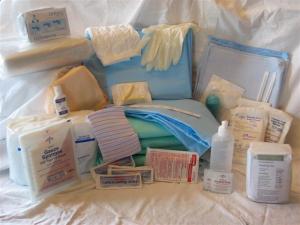
Most midwives will have you purchase a birth kit for the big day. These kits can be bought on-line. You midwife might have a specific place they like to order from so talk to them about what you should get. Here is a sample birth kit and some on-line places to order from.

A Sample Birth Kit Includes:
10-23×24 Underpads, Economy
5-23×24 Underpads, Economy
2-40×60 Plastic Backed Sheets
1-Peri Bottle
1-Stockinette Newborn Hat
6-2.7gram Packets Sterile Lubrication
2-Plastic Cord Clamps
1-Paper Tape Measure
12-Alcohol Prep Pads
2-Flex Straws
1-Dozen Sanitary Pads
12-Sterile 4×4 Gauze Pads
1-Bulb Syringe 2.5 ounces
1-Mesh Brief
3-Pairs Sterile Gloves
6-Single Sterile Gloves
1-4 ounce Povidone Solution
1-“Welcome” Birth Certificate
1-Disposable Footprinter

http://www.midwifesupplies.com/Home-Birth-Kits-PEA0059-p-BirthKits.html
http://inhishands.com/

A SAMPLE CHECK LIST OF THINGS NEEDED FOR A HOME BIRTH
From http://pregnancy.about.com/od/homebirth/a/supplylist.htm

  • A bottle of isopropyl rubbing alcohol (70%)
  • A pint of 91% alcohol (or 99% alcohol, grain alcohol, or 180 proof Golden Grain
  • Cotton balls
  • A plastic drop cloth or plastic sheet (an old shower curtain or large plastic table cloth works wonderfully)
  • Plastic trash bags (AT LEAST 4 large) dark colored
  • 2 fitted bed sheets to fit your bed
  • 2 flat bed sheets to fit your bed (4 flat sheets is acceptable)
  • 4 bath towels
  • 4 wash cloths
  • 8 receiving blankets
  • Large mixing type bowl
  • Small mixing type bowl (prefer bowls not be glass)
  • Working flashlight and extra batteries
  • Extra toilet paper (at least 2 6-roll packs)
  • Several kinds of juice (at least one citrus and 1 non-citrus)
  • One extra bag of ice
  • Protein you like that is easy to fix (peanut butter, cheese, or eggs for example)
  • Clothes for you for after the birth (gown and panties)
  • Clothes for the baby (2 pair socks or booties, 2 onesies, 2 sleepers)
  • Diapers for the baby
  • Large cookie sheet
  • Silver duct tape (preferably new roll)
  • Thermometer (if digital, include probe covers)

We organized the kit and all the extra supplies she requested (towels, washcloths, etc) into 2 large Rubbermaid bins and stored them under a 4 foot table we set up in our room – also requested by midwife.  Once labor started, we made up the bed with plastic and a new set of sheets.  We purchased a roll of clear plastic, self-sticking carpet protector (like they use in model homes) and covered our carpeted bedroom floor with it.

Another mom was caught off guard with a 36 week labor and delivery:

We’d wanted a water birth at home but our little one arrived 4 weeks earlier than we thought so we were truly unprepared. In fact, the birth kit that we ordered arrived via UPS about 3 hours after our baby was born. Fortunately our midwives always have a birth kit on hand just for these types of situations.

DO YOU GO TO A REGULAR DOCTOR’S OFFICE FOR YOUR CHECK-UPS IF YOU ARE HAVING A HOME BIRTH?
Whether or not visits are in the midwives’ office or at your house likely depends on the midwife you choose.

  • If you choose prenatal screening or to have an ultrasound this would occur in a clinic and you will need a referral from your midwife for the procedure.

PEOPLE YOU MIGHT WANT PRESENT AT YOUR HOME BIRTH

  • Midwives
  • A doula
  • Back-up midwife (probably already arranged by your midwifery group)
  • Friends
  • Family

If there are other children in your family, you might arrange to have a friend or family member be on-call to care for the child or children during the birth.

WHEN TO CALL THE MIDWIVES
You and your midwives will discuss at what point they would expect for you to call them in. If you have a doula, she can help you with this decision as well. Some laboring at home before the arrival of the midwife is normal.

When my water broke and I had started having semi-regular contractions, we called the midwife.  She came over within an hour or so because she happened to be in the area. 

WHO ASSISTED YOU WITH LABOR?
My husband and my midwives helped take me through all my rushes. We chose to call them rushes instead of labor since the word labor had some negative connotations for me. My daughter also helped with kind words, nice touches, and videotaping her brother’s birth, announcing the gender and the name!

WHAT WOULD YOU LIKE TO TELL SOMEONE CONSIDERING A HOME BIRTH?
I knew of women having their babies in places other than hospitals, but I honestly thought they were super hippies willing to have their babies in the woods, gnawing off the umbilical cord and eating the placenta on the spot. I had no idea that, for instance, where our home is situated has one of the highest rates of homebirths in the city.

It is SO much safer than hospital birthing. You can have your baby right at home and then you’re right there in your nest where you need to be. A home birth is intense and powerful. You don’t need to have a fancy house or apartment. You don’t need to have a clean house. There will be blood, there will be fluids, but the midwives know what they’re doing and they’ll clean up! Women need to know they can do it! People planning a home birth need to know that birth in a hospital is an odd new trend…birthing at home is the normal way to bring babies into the world. Women have been birthing babies in their “nests” since the beginning of time. In my opinion, hospitals have it all backwards and actually make birth harder. Home birth is simple. It un-complicates a very natural process.

ADVICE AND TIPS FOR THE HOME BIRTH

  • I would have planned a little earlier so I could have had a water birth.
  • I think I would have done a little more mental hypno-birthing preparation before my home birth.
  • I would also have liked to watch some home births on video.
  • We made the HUGE mistake of not hiring a doula!
  • Tour your local hospital in the event you need to transfer.
  • I also ate a high protein diet in an attempt to avoid pre-eclampsia and thus a birth too early for staying at home. 
  • I did pre-natal yoga and visited the chiropractor, though both not as often as I should have all during pregnancy and definitely not enough during those last few crucial weeks.

WATER BIRTHS AT HOME
Besides being a great comfort measure, a water birth can offer the following and more:

  • diminish stress hormones (called catecholamines) which increase pain and slow labor
  • reduce pain by increasing the body’s production of natural pain relievers (endorphins)
  • ease involuntary muscular tension, and enhance relaxation during and between contractions
  • lower blood pressure within minutes and decrease edema (swelling),
  • promote better circulation and increase the efficiency of uterine contractions
  • increase mobility so that it is easier to change positions to aid the progress of labor, especially when a woman is becoming tired

http://www.geneabirth.com/waterbirth.htm

If you want to have a water birth at home you will need to rent a BIRTHING TUB. Check with your birthing center or midwife to see where you can rent a birthing tub locally. Some birthing centers and midwife organizations will rent tubs, too.

In the Twin Cities these organizations will bring the tubs to your home, give you the instructions as to how to set it up, and will take the tub down for you after the birth. They also supply a list of things you will need for tub rental.

http://www.waterbirthresources.com/
http://bywaterbirth.com/
http://www.geneabirth.com/waterbirth.htm

BIRTHING STOOL

It is common for women giving birth at home to rent a birthing stool. They are made in all shapes and sizes. The above stool is a handcrafted wood stool.

 “A birthing stool is a stool which has been specifically designed for use during childbirth. It allows a woman to sit or squat while giving birth with support to help her if she begins to feel fatigued. Many advocates of natural birth support the use of a birthing stool, which may also be called a birth support stool or a birth stool. Such stools are available from companies which provide equipment to midwives, and they can also be handmade; some people have chosen to make their own to personalize the labor and delivery process.”

The concept of sitting or squatting during labor is ancient, and widely practiced in many cultures, and the use of the birthing stool is also quite old. A birthing stool is designed to bear up to a substantial amount of weight and pressure, and it is usually low to the ground so that a laboring mother can plant her feet firmly. Most importantly, a birthing stool has a hole in the middle, allowing a midwife to monitor the progress of the labor and providing a space for the baby to slide through.”

http://www.wisegeek.com/what-is-a-birthing-stool.htm

Your midwives might be able to advise you on were to go locally or on-line for this as well.

Video on the Birthing Stool: http://www.youtube.com/watch?v=RrXR7dK4Y2k

HOME VERSUS HOSPITAL: HANDLING POSSIBLE COMPLICATIONS

This labor and birth was way harder than my first due to what turned out to be a crooked (asynclitic) baby.  I know one thing for SURE—I would not have been as comfortable in a hospital as I was at home to birth in so many different positions, to walk around, to be naked, get in and out of tub, to vocalize, etc.  I think we would have had a very different outcome for this birth if we had NOT been at home.

I actually had some bleeding 3 days before I gave birth and because I was only 36 weeks, my midwives instructed me to meet them at the hospital because early bleeding could mean placenta previa…and if it was placenta previa I would need an emergency c-section. Placenta previa occurs when the placenta grows in the lower part of the womb and covers the cervix. This is very bad as you cannot push the life-giving placenta out first since both baby and mother would likely die. I hadn’t had any ultrasounds during my pregnancy, but I had to have one to ensure the placement of the placenta was at a safe location. It was. And even while I spent 10 hours in the hospital in contractions at only 36 weeks…I opted to return to my home though the MD there strongly advised me to remain at the hospital to have my baby. But I chose to voluntarily discharge. I felt like royalty walking out of the OB floor waving at the labor and delivery nurses as they stood with jaws dropped at a woman walking OUT of the hospital while in labor. 

FOR THE SIBLINGS

http://www.midwifesupplies.com/Were-Having-A-Homebirth-KM0050-p-BirthKits.html


LOCAL MINNESOTA BIRTH CENTERS AND MIDWIVES

Many thanks to Barbara Morgan and Claire DeBerg for their assistance with this article and for sharing their home birthing experiences and knowledge!

Mother-Baby Separation: The First Three Years

The following article is very much in line with my thinking about parenting. As a single mother who works, it is difficult to maintain this proximilty to my child. However, I value the co-sleeping time with my child and view it as valuable parenting and bonding time. Christina.

Mother-Baby Separation

By Dr. George Wootan, M.D., Author of Take Charge of Your Child’s Health

http://www.drmomma.org/2010/07/mother-toddler-separation.html

I’m going to open up a big can of worms here, one that gets me into as much trouble as my thoughts on weaning: mother-baby separation. Imagine for a moment, that you are at the grocery store with your six-month-old. She starts making hungry noises, and you look down and say reassuringly, “I’ll feed you in half an hour, as soon as we get home.” Will she smile and wait patiently for you to finish you shopping? Absolutely not! As far as your baby is concerned, either there is food now, or there is no food in the world. Right in the middle of the grocery store, famine has struck!

Babies and toddlers, up to the age of about 36 months, have little concept of duration of time. To them, there are only two basic times: now and never. Telling a young toddler that Mommy will be back in an hour, or at 5:00, is essentially the same thing as telling her that Mommy is gone forever, because she has no idea what those times mean.

Let me submit to you that the need for mother is as strong in a baby as the need for food, and that there is no substitute for a securely attached mother. When he’s tired, hurt, or upset, he needs his mother for comfort and security. True, he doesn’t need Mommy all the time, but when he does, he needs her now. If he scrapes his knee, or gets his feelings hurt, he can’t put his need on hold for two hours until Mommy is home, and the babysitter – or even Daddy – just won’t do as well as if Mommy was there.

So, yes, this is what I’m saying: A mother shouldn’t leave her baby for an extended amount of time until about the age of 36 months, when he has developed some concept of time. You’ll know this has begun to happen when he understands what “yesterday,” “tomorrow,” and “this afternoon” mean, and when your toddler voluntarily begins to spend more time playing away from you on his own accord.

Of course, if you know that your child always sleeps during certain times, you can leave her briefly with someone while she naps. If you do this, however, the babysitter should be someone she knows well, as there is no guarantee that she won’t choose this day to alter her schedule and wake up while you’re gone. This could be traumatic for her if the person is someone she casually knows, and doubly so if the babysitter is a stranger. It is important to make every effort to be available to her when she is awake and may need you.

I realize that not separating a baby from his mother for the first 36 months of life may be difficult. Living up to this presupposes that the family is financially secure without the mother’s paycheck, and, unfortunately, this is not a reality for some people. I would not argue that a mother who must work to support her family is doing less than her best for her children by working. However, I believe that many women return to work not out of necessity, but because they (or their spouses) want to maintain the two-income lifestyle to which they’ve become accustomed. These parents need to do a little soul-searching about what they really need and not sacrifice their child’s best interests.

If you must leave your baby for several hours a day, there are some things you can do to try and compensate for the separation. One of these, of course, is nursing until the child weans himself. Another is sharing sleep with your child until he decides he is ready for his own bed. If you have to spend 8 hours away from your baby, make an effort to spend the remaining 16 hours of each day in close physical contact. That extra effort will go a long way toward helping him feel secure an develop a healthy attachment with you.

In our family, we have found that many events that would require leaving our baby or toddler at home are the ones that we don’t particularly mind missing. We also have found that because our children have their needs attended to promptly, they are happy and secure, and we are able to take them to most social gatherings. I don’t mean to suggest that you’ll never encounter any problems, but generally, you’ll find that if you take care of your baby’s immediate needs by holding him, nursing him, and loving him, he’ll be a pleasure to have around, well into the toddler years and beyond.


George Wootan, M.D. is a board-certified family practitioner and medical associate of La Leche League International. He and his wife, Pat, are the parents of eleven children and the grandparents of twenty-one. Dr. Wootan has practiced medicine for 33 years with a focus on pediatric, family, and geriatric care and chronic illness. He speaks nationally on the subject of children’s health, healthy aging, nutrition, wellness and Functional Medicine.


Positive Parenting: Time Outs May Not Be the Best Choice

http://www.sheknows.com/parenting/articles/805746/positive-discipline-why-timeouts-dont-work


By Susan Stiffelman

Susan Stiffelman is a licensed marriage and family therapist, educational consultant and parenting coach. Through her private practice, public presentations, workshops, teleclasses and website, she has become a source of advice and support for parents around the world. Her book, Cool, Calm and Connected: How to Avoid Negotiations, Arguments and Meltdowns With Your Kids is now available in bookstores. Susan can be reached at www.passionateparenting.net.

Do time-outs work as punishment for children? Family therapist and author Susan Stiffelman explains why they don’t work, why they can actually cause clinginess in your child — and what techniques are much more effective.

There’s no doubt about it: Time-outs work. Sort of. They work because unless a child has become hardened and aloof, the experience of being separated from a parent’s comforting presence is unpleasant at best and intolerable at worst. But they come at a price, and eventually they stop working –because they violate one of the three primary drives of a child’s brain: the need for close and secure attachment.

Children need a secure attachment

Children are wired to be closely connected to their caretakers. Attachment is vital to their survival and well-being. Unlike the young of other mammals, little humans are utterly dependent on their guardians to provide food, warmth, shelter and nurturing; we simply cannot survive without being connected to those who care for us.

When a misbehaving child is sent to their room to “think about” their offense, the only thing they’re really thinking about is either how soon they can get back to Mommy or Daddy or how much they hate their parent for sending them away.

The former response is what we initially see in a younger child whose experience of anxiety at being separated from the parent shoots through the roof. The latter response — anger and contempt — happens when the child feels outraged at being ostracized.

What role does discipline play in parenting?

Why time-outs don’t work

The problems with time-outs are numerous. First, at the very time when the angry or misbehaving child is out of control and in need of the calming influence of a caring parent, they’re left to settle down entirely on their own. Most children are incapable of doing this. They need a grown up to help them come back to themselves when they’re swept up in the storm of their emotions. A child whose behavior has been so impulsive or destructive as to warrant being sent away shouldn’t be left to his own devices to become centered again.
 
Sending a child away when they’re distressed is essentially saying to them, “I can’t handle you when you show this side of yourself. Come back when you can be the manageable Susie or Johnny that I can handle.” Not only are we telling the child that we only find the good, compliant version of themselves acceptable, we’re also declaring our inability to cope with all of who they are.

As I’ve said in many other articles, a child deeply needs their parent to function as the confident Captain of the ship in their life. When a parent sends a child away because they can’t handle their misbehavior, they’re effectively telling them that they (the child) have the power to render them (the parent) incompetent and helpless.

Time-outs increase separation anxiety

One of the characteristics I see in children whose parents routinely use time-outs is clinginess. Unless (or until) these kids become hardened and indifferent, they handle separation badly. While it usually works to tell a child who refuses to leave the park, “Okay, then, I’m leaving without you!” (most kids will indeed come running), the anxiety created by chronically threatening a child with separation damages their core sense of security and connection.

Time out for time outs?

What can you do?

When a parent functions as the Captain of the ship in their child’s life, there’s a natural dynamic at play that makes time-outs largely unnecessary. Sure, there are always times when our kids are cranky, hungry, jealous or running on empty, but if we do our best to anticipate problems before they manifest, we can usually avoid behavior getting out of hand.

For all practical purposes, time-outs are the equivalent of shunning a child. In most societies, shunning is considered the most dreadful form of punishment. When we instead manage a child’s misbehavior while preserving their sense of connection with us, we avoid the harmful effects of time-outs — which in the long run, create more problems than they solve.

How can you become the Captain of the ship in your child’s life, parenting without needing to bribe, threaten or resort to time-outs? Click here to read, “Avoiding power struggles: Parenting without bribes or threats.”

More on discipline