Are kids getting too much screen time? Parents aren’t sweating it

Kids on screens

This article illustrates a major problem in today’s society of child-rearing: Parents don’t see screen time as an issue with their children. According to this research article, content is a concern to parents, but QUANTITY? Not so much.

http://www.latimes.com/news/science/sciencenow/la-sci-sn-study-parents-use-20130604,0,7254966.story

Are kids getting too much screen time? Parents aren’t sweating it

By Deborah NetburnJune 4, 2013, 6:35 p.m.

Among the zillions of decisions that moms and dads make about how to parent,  it might seem that determining the appropriate amount of time young children can spend watching TV and playing on tablets and smart phones might be big one.

But it turns out that’s not the case. Most parents of children younger than 8 don’t give the matter much thought, researchers from Northwestern University found in a recent study.

Just 31% of the 2,300 parents surveyed expressed concern about their children’s media and technology use, while more than 55% of parents said they are not worrying about the amount of time their children spend staring at screens much at all.

And while 38% of parents said they were fearful their children could get addicted to hand held devices like tablets and smart phones, 55% said they aren’t sweating it.

(If you are anything like me, and have had the experience of trying to pry an iPhone out of the clutches of a screaming 2-year-old, you are now feeling very out of sync with your fellow American parents).

“It was completely surprising to me,” said Ellen Wartella, director of Northwestern University’s Center on Media and Human Development and the lead researcher on the study in an interview with the Los Angeles Times. “It’s a generational shift. What we are seeing is a generation of parents who recognize that what kind of content you are exposing your kids to matters more than how much.”

The study, titled Parenting in the Age of Digital Media, held other surprises as well. For example, although 71% of parents had a smartphone in the home, nearly the same percentage said they did not think that having a smartphone or tablet device made parenting easier.

The study also revealed that most parents do not rely heavily on digital devices to distract their children. When Mom or Dad needs a moment to cook dinner or clean up the house, parents said, they are more likely to set their kid up with a toy or an activity (88%), a book (79%) or TV (78%) rather than handing over a smartphone or tablet (37%).

“Parents have a lot of tools they can use and media and technology are just one of those tools,” said Wartella.

Finally, the researchers found children’s media use is largely determined by the media environment that the parents have established in the home, rather than the result of a media obsessed kid clamoring for just one more show, or just one more app.

Of the families interviewed for the study, 38% fell into a category the researchers dubbed  “media-centric.” These are families where the parents enjoy watching TV and using the computer and smartphone at home, spending an average of 11 hours a day looking at various screens. The children of these parents, on average, spend four hours and 40 minutes a day looking at screens, the researchers found.

Some 45% of families fell into a “media-moderate” category where the parents spend a little less than 5 hours a day looking at screens. Their children, in turn, look at screens just under three hours a day.

And children in “media-light” families, where parents spend less than 2 hours a day looking at screen media, look at screen media themselves for an hour and 35 minutes on average.

“Instead of a battle with children on one side and parents on the other, media and technology has become a family affair,” the researchers conclude.

Meditation goes mainstream

Meditation goes mainstream

http://m.startribune.com/?id=209378341

With doctors prescribing it and scientists swearing by it, you clearly don’t need to be a monk to meditate. Enthusiasts have even given it a new name:”mindfulness.”

Article by: Jeff Strickler , Star Tribune

Updated: May 29, 2013 – 6:08 PM

When the Rev. Ron Moor began meditating 30 years ago, he did so in secret.

“When I started, meditation was a dirty word,” said Moor, pastor of Spirit United Church in Minneapolis. “[Evangelist] Jimmy Swaggart called it ‘the work of the devil.’ Because of its basis in Eastern religions, fundamentalists considered it satanic. Now those same fundamentalists are embracing it. And every class I teach includes at least a brief meditation.”

The faith community isn’t alone in changing its attitude. Businesses, schools and hospitals not only have become more accepting of meditation, but many offer classes on it. Meditating has gone mainstream.

Why? “Because it works,” Moor said.

Adherents have been saying that for centuries, of course, but now there’s a difference: Scientists can prove it.

Propelled by technological breakthroughs in neuroscience enabling researchers to monitor brain activity, the medical community is awash in studies showing that meditating has beneficial physical effects on the brain. Those studies are being joined by others demonstrating that advantages include everything from raising the effectiveness of flu vaccines to lowering rejection rates for organ transplants.

“Meditation has become a huge topic” in medical circles, said Dr. Selma Sroka, medical director of the Hennepin County Medical Center (HCMC) Alternative Medicine Clinic. “The health benefits are so strong that if nothing else, people should learn the relaxation techniques.”

The practice is being embraced by an audience that isn’t interested in its religious contexts, typically Buddhist or Hindu, but is fascinated by its mechanics and techniques. Sroka compared the West’s co-opting of meditation to what happened to yoga, which came to this country as a spiritual discipline and has morphed into a form of physical fitness.

Some would-be meditators opt simply to ignore the religious element, said Mark Nunberg, co-founder of Common Ground Meditation Center in Minneapolis. Although his center is a Buddhist organization, at least half the people who enroll in classes are there just for instruction in meditation, he said.

“It’s the same practice” whether it involves religion or not, he said. “It’s training the mind to be in the present moment in a relaxed way. It’s the most practical thing in the world; some might even say it’s just common sense.”

What’s in a name?

You don’t have to call it meditation. In fact, Sroka said, a lot of people would prefer that you don’t.

Terms such as “mindfulness stress reduction” and “relaxation response” are less threatening to some folks. They also make it easier to introduce the practice in offices and schools, where even a tangential reference to religion can raise red flags.

Since 2001, doctors doing their residencies in HCMC’s family medicine program have been required to take a class in meditation, not necessarily to pass on the information to their patients — although they are encouraged to do so, Sroka said — so much as to help them deal with the stress of their jobs. At first, the program ran into resistance. Then the hospital quit calling it meditation.

“I think a lot of it is in the language,” she said. Because of meditation’s association with Eastern religions, “members of other religions often are uncomfortable with the term. People want to know that I’m not selling them a religion.”

The scientific community’s interest in meditation springs from tests in which electrodes attached to subjects’ heads show their brains calming down during meditation, lowering stress levels and increasing the ability to focus.

The tests are generating so much interest that leading experts have almost become rock stars. In October, 1,200 people turned out for a lecture by Dr. Richard Davidson at the University of Minnesota’s Center for Spirituality and Healing. Davidson is a professor at the University of Wisconsin who has been on the cutting edge of using neuroscience to monitor meditation-induced changes in the brain.

He is convinced that the brain can be trained to deal with stress the same way a muscle can be conditioned to lift a heavy weight.

“Training the mind can lead to changes in the brain,” he said.

Flexing your mind muscle

On the Minneapolis campus of the University of Minnesota, the Mindfulness for Students club meets every Friday for a 90-minute meditation. Attendance tends to surge right before finals.

“It’s a great way to deal with stress,” said Stefan Brancel, a junior who is president of the club. Meditation “makes you capable of stepping back and taking a bigger perspective instead of getting lost in the stress. Once you step back and see the situation for what it is, you can react to it.”

The surge in scientific research focuses on brain imaging. The best known device is functional magnetic resonance imaging (fMRI), which produces color-coded cross-section diagrams showing how the neurons in the brain are firing.

Davidson has used this imaging with Tibetan monks. While his findings have been stunning, questions arise over their applicability to the general public. Studying the brain waves of people who meditate for several hours a day is comparable to measuring physical fitness in Olympic athletes, critics say. The results might be impressive, but what do they mean for the average person?

That’s why Mary Jo Kreitzer, founder and director of the Center for Spirituality and Healing, is excited about studies of meditation newcomers. Researchers at the University of Massachusetts have documented changes in the brains of novice practitioners who took an introductory eight-week class and meditated as little as 15 minutes a day.

Sroka said that the techniques can become second nature. In times of stress, “you slow down and breathe slowly,” she said. “You get to the point where you do it routinely without even being aware of it.”

Kreitzer agrees. “Mindfulness is an attitude that you carry with you,” she said. “I think mindfulness really helps us move through life with ease.”

She also challenges the notion that meditating requires a special room filled with incense, soothing music and floor mats on which practitioners twist themselves into the lotus position.

“You can sit, you can stand, you can walk,” Kreitzer said. “I wouldn’t advise doing it while you’re driving, but other than that, meditation can be done anywhere.”

Jeff Strickler • 612-673-7392

Heartfelt Crafts: Fabric Flower Prints

pansy  IMAG1976

There was an open house at a “natural” craft store for kids this week and it was GREAT!  http://www.heartfeltonline.com/

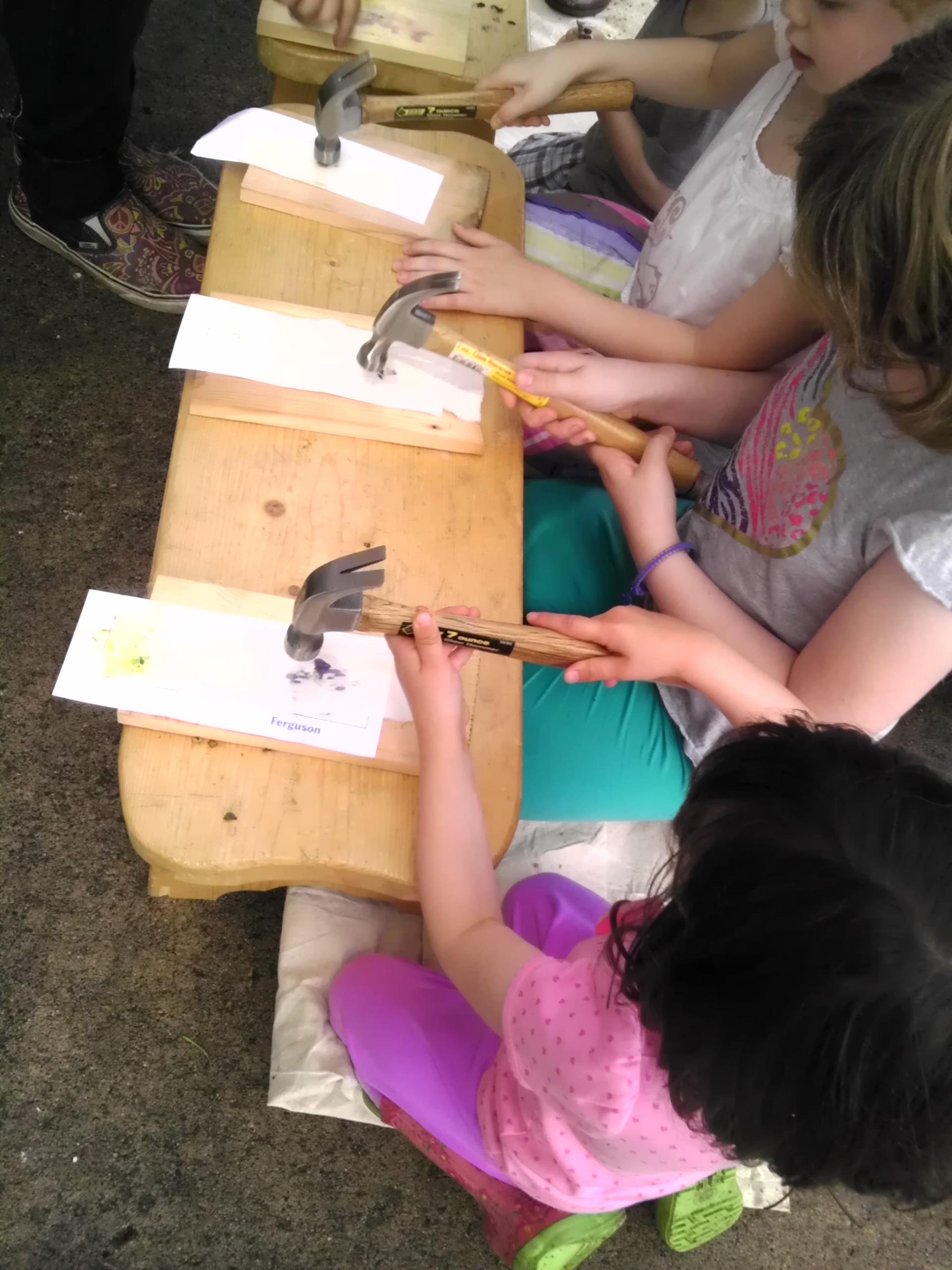
The first project we did was to create flower prints on muslin (available at any fabric store).

Here are the instructions to make your flower/fabric print.

1. Place a piece of scrap paper on a piece of wood.

2. Put the flower on top of the paper.

Image

3. Cover the flower with a piece of muslin and start hammering gently.

Image

As you hammer, the color from the flower bleeds through.

Image

Image

To set the color in the fabric, iron it between two pieces of fabric.

Get creative and use different sizes of fabrics and different color flowers. The sky is the limit.

Frame and hang. It’s as simple as that and is really beautiful!

Skills: Appreciation of nature, manual dexterity, fine and gross motor coordination, recognition of colors, physical properties of flowers, art.

Children Can Meditate Too

ImageI LOVE this concept. Children meditating. Children engaging in stress-reducing activities at a young age. My daughter has learned “The Volcano Breath” at school.

They rub their hands together while calming and then blast them into the air with a big out breath! I use it when things are getting riled up in the household and the energy level is about to blow off the roof.

“Volcano breath, Honey! Quick, Volcano Breath!”

She stops whatever whirlwind she’s in the middle of and runs to me all smiles. She quick starts rubbing her hands together and then blast-off! 

She’s calm, if only for a minute.

This is from an article I cut out on the topic of health and mindfulness meditation:

http://ecologyhealthcenter.net/node/1064

“A few minutes of daily mindfulness meditation can help take attention away from tummy troubles of all kinds for school-age kids, too.

Here’s one way to get started:

Have your child hold a flower (or another small, pretty object) in her hands. Encourage her to pretend she’s never seen a flower before, and have her describe what it looks like, what it smells like, how the petals feel—even what it sounds like. Gaylord says that focusing on something other than symptoms brings a person’s attention into the present moment—helping her think less about stomach pain or anxiety.”

Let’s try it! Find ways to integrate “living in the moment” into our children’s live. Let’s work on those self-calming strategies if only for a few moments or perhaps before going to bed.

There’s more to explore on this topic and I’m looking forward to it. I’m guessing that nature has its own natural sedative properties…how can they be put to use in this process?!

Helping the Women of Assam, India

women weavers

Yesterday I cooked Indian food for my good friend Mili who has been raising money to help impoverished children and women in India with her annual fundraiser. This year they are supporting women in Assam (the part of India she is from) to purchase and use more efficient looms and to have better access to markets to sell their wares at fair wages. If you can help by donating something (anything really – even a few dollars), it would mean a lot to me and to Mili and to the women of Assam!

https://www.youtube.com/watch?feature=player_embedded&v=Wm9NfhD_g5c

Here’s a link to one of the dancers at the fundraiser last night.

Those who wanted to come and support and could not make it, it is still not too late… You could still help us by writing a check to AFNA (Assam Foundation of North America) and send it to Mili Dutta, 3233 Columbus Ave S, MN 55407.
 
She wanted to raise $5000 and so far they have raised $4309.

So, if you would like to support her and help her to reach her goal, then PLEASE send a check or use the following paypal link…https://www.paypal.com/cgi-bin/webscr?cmd=_donations&business=CZYN3ADB9UDM4&lc=US&item_name=Assam+Foundation+of+North+America&item_number=2000&currency_code=USD&bn=PP-DonationsBF%3Abtn_donateCC_LG.gif%3ANonHosted

 
Thank you to all who believe in social justice and helping the underserved…


It will only make a few minutes of your time and could make the difference in the life of a woman.

More Support for the Out of Doors (Nature and Children)

IMG_6867

20 Reasons Why Playing Outdoors Makes Children Smarter

http://www.houstonfamilymagazine.com/exclusives/20-reasons-why-playing-outdoors-makes-children-smarter/

By Stacey Loscalzo

Author and clinical psychologist, Kay Redfield Jamison, writes, “Children need the freedom and time to play. Play is not a luxury. Play is a necessity.” It is through unstructured, open-ended creative play that children learn the ways of the world. While playing outside, children explore with all their senses, they witness new life, they create imaginary worlds and they negotiate with each other to create a playful environment.

1. Outdoor play is a multi-sensory activity. While outdoors, children will see, hear, smell and touch things unavailable to them when they play inside. They use their brains in unique ways as they come to understand these new stimuli.

2. Playing outside brings together informal play and formal learning. Children can incorporate concepts that have learned at school in a hands on way while outdoors. For example, seeing and touching the roots of a tree will bring to life the lesson their teacher had taught about how plants get their nutrients.

3. Playing outdoors stimulates creativity. Robin Moore, an expert in the design of play and learning environments, says, “Natural spaces and materials stimulate children’s limitless imagination and serve as the medium of inventiveness and creativity.” Rocks, stones and dirt present limitless opportunities for play that can be expressed differently every time a child steps outside.

4. Playing outdoors is open ended. There is no instruction manual for outdoor play. Children make the rules and in doing so use their imagination, creativity, intelligence and negotiation skills in a unique way.

5. Playing in nature reduces anxiety.Time spent outside physiologically reduces anxiety. Children bring an open mind and a more relaxed outlook back inside when they are in more traditional learning environments.

6. Outdoor play increases attention span. Time spent in unstructured play outdoors is a natural attention builder.Often children who have difficulty with pen and paper tasks or sitting still for longer periods of times are significantly more successful after time spent outside.

7. Outdoor play is imaginative. Because there are no labels, no pre-conceived ideas and no rules, children must create the world around them. In this type of play children use their imagination in ways they don’t when playing inside.

8. Being in nature develops respect for other living things. Children develop empathy, the ability to consider other people’s feeling, by interacting with creatures in nature. Watching a tiny bug, a blue bird or a squirrel scurrying up a tree gives children the ability to learn and grow from others.

9. Outdoor play promotes problem solving. As children navigate a world in which they make the rules, they must learn to understand what works and what doesn’t, what line of thinking brings success and failure, how to know when to keep trying and when to stop.

10. Playing outside promotes leadership skills. In an environment where children create the fun, natural leaders will arise. One child may excel at explaining how to play the game while another may enjoy setting up the physical challenge of an outdoor obstacle course. All types of leadership skills are needed and encouraged.

11. Outdoor play widens vocabulary. While playing outdoors, children may see an acorn, a chipmunk and cumulous clouds. As they encounter new things, their vocabulary will expand in ways it never could indoors.

12. Playing outside improves listening skills. As children negotiate the rules of an invented game, they must listen closely to one another, ask questions for clarification and attend to the details of explanations in ways they don’t have to when playing familiar games.

13. Being in nature improves communication skills. Unclear about the rules in an invented game? Not sure how to climb the tree or create the fairy house? Children must learn to question and clarify for understanding while simultaneously making themselves understood.

14. Outdoor play encourages cooperative play. In a setting where there aren’t clear winners and losers, children work together to meet a goal. Perhaps they complete a self-made obstacle course or create a house for a chipmunk. Together they compromise and work together to meet a desired outcome.

15. Time in nature helps children to notice patterns. The natural world is full of patterns. The petals on flowers, the veins of a leaf, the bark on a tree are all patterns. Pattern building is a crucial early math skill.

16. Playing outdoors helps children to notice similarities and differences. The ability to sort items and notice the similarities and differences in them is yet another skill crucial to mathematical success. Time outdoors affords many opportunities for sorting.

17. Time spent outdoors improves children’s immune systems. Healthy children are stronger learners. As children spend more and more time outdoors, their immune systems improve decreasing time out of school for illness.

18. Outdoor play increases children’s physical activity level. Children who play outdoors are less likely to be obese and more likely to be active learners. Children who move and play when out of school are ready for the attention often needed for classroom learning.

19. Time spent outdoors increases persistence. Outdoor games often require persistence. Children must try and try again if their experiment fails. If the branch doesn’t reach all the way across the stream or the bark doesn’t cover their fairy house, they must keep trying until they are successful.

20. Outdoor play is fun. Children who are happy are successful learners. Children are naturally happy when they moving, playing and creating outside. This joy opens them up for experimenting, learning and growing.

 Bio: Stacey Loscalzo is a freelance writer and mother of two girls living in Ridgewood, NJ. She and her girls have been getting outside to play for nearly a decade.

Breastfeeding for Six Months Can Significantly Cut Risk of Cancer Death

new 167

Breastfeeding for Six Months Can Significantly Cut Risk of Cancer Death—As Can Less Alcohol and Staying in Shape, Study Finds
By Beth Greenfield, Shine Staff

PostsBy Beth Greenfield, Shine Staff | Healthy Living

Breastfeeding is good for you, study says.

Women still confused by the breast milk vs. formula debate may want to listen up, as a new study has found exclusively breastfeeding your baby for at least six months could cut your chances of dying from cancer and all other diseases by 17 percent—and death by heart disease alone by 8 percent.

The mass study, published online Wednesday in the American Journal of Clinical Nutrition, examined breastfeeding and other lifestyle recommendations from the American Institute for Cancer Research (AICR) and its umbrella World Cancer Research Fund International and their effects on nearly 380,000 people in several European countries over 13 years.

It found that both women and men could cut their risk of death on average by a third, simply by adhering to one or several healthy lifestyle choices: keeping lean but not underweight, eating a plant-based diet, being active for at least 30 minutes daily, avoiding sugary drinks and highly caloric foods, lowering meat intake, and limiting alcohol intake.

But findings on the additional breastfeeding recommendation for women represented perhaps the freshest recommendation in the mix.

“No previous study has investigated the association between breastfeeding and mortality in the mother,” lead researcher Anne-Claire Vergnaud told Yahoo! Shine. Dr. Vergnaud, of London’s Imperial College faculty of medicine, added that a previous study found “failure to breastfeed” related to an increased risk of premenopausal breast cancer, ovarian cancer, diabetes and other conditions.

There are several connections between breastfeeding and longevity, AICR Director of Research Susan Higginbotham explained to Yahoo! Shine. “Longer breastfeeding means fewer menstrual cycles and reduced lifetime exposure to the hormonal factors, especially estrogen, that influence breast cancer risk,” she said. “Physical changes in breast tissue that accompany milk production provide some protection as well.” She added, that the shedding of breast tissue during lactation and the cell death after also decrease cancer risk, “because cells have potential DNA damage get shed before they can spark the cancer process.”

There are even benefits for the baby, Dr. Higginbotham said, as breastfeeding decreases the likelihood that a child will be overweight during early adulthood, and being obese or overweight are major risk factors for seven different kinds of cancer.

Currently, only 16 percent of women in the U.S. exclusively breastfeed their babies for six months, according to the CDC. That percentage jumps to 36 for those exclusively breastfeeding for three months, and 47 for those who breastfeed for six months but combine it with using other nutrition sources.

For the study, researchers examined the data from the European Prospective Investigation into Cancer (EPIC), one of the world’s largest ongoing studies of diet, lifestyle and cancer. At the end of the study, nearly 24,000 participants had died of various causes. Participants in the highest healthy-lifestyle score category (5-6 points for men, 6-7 points for women) had a 34 percent lower chance of death than those in the lowest category (0-2 points for men, 0-3 points for women).

But even adhering to just one of the lifestyle recommendations—developed by AICR and WCRF in 2007—can save your life, according to the report. Maintaining a healthy BMI, for example, can lower your risk of disease-caused mortality by 22 percent, while eating a plant-based diet can lower it by 21 percent.

“We’ve known for years that following AICR’s lifestyle advice could cut the worldwide incidence of cancer cases by about one-third,” Dr. Higginbotham said of the study results. “Today we have evidence on mortality, which shows that this same practical advice could also save millions of lives from cancer and other chronic diseases around the world.”

Cinderella is Eating my Daughter and So is the Media

So recently my three year old has decided that being a princess is the way to go. She has princess pants, princess dresses, princess skirts, and best of all, a princess dance. (None of these clothes actually have princesses on them. It’s just a matter of what she feels like wearing that day that makes it princess or not.)

It is fitting that I’m sitting by and watching the transformation of my regular old daughter into mini royalty as I am currently reading a book called “Cinderella Ate My Daughter: Dispatches from the Front Lines of the New Girlie-Girl Culture” by Peggy Orenstein.

I’m only shortly into the book but I’ve already read some fascinating information. Here are two studies by researchers that really caught my attention.

The First Study

Researchers took two groups of middle school age girls and showed them a series of commercials and then had them fill out a survey asking them what they wanted to be when they grow up.

One of the groups watched commercials of neutral things like phones and pens.

The second group of students watched the same commercials but this time they added two commercials that showed women in traditional gender roles. The commercials were for things like acne medicine or brownies with images of women smiling over the stove.

After the kids watched the commercials they had them fill out a questionnaire asking them about what careers they might be interested in.

The girls that watched the commercials that had the women doing things like fretting about their skin or cooking brownies showed less interest in science and math based careers.

Think about this outcome. What does t.v. and the media do to our children and specifically to our little girls and women of the future?

The Second Study

Researchers took two groups of college students and had them try on either a sweater or a bathing suit before taking a math test. These were all students that were good at math. They then looked at the scores to see if there were any differences that would not be due to chance.

This is what they found.

The young women who took the math test after trying on the bathing suit did worse than the group of women who tried on the sweater before taking the math test.

The boys did the same on the test regardless of whether they tried on a bathing suit or a sweater.

Body image. Self esteem. How we feel about ourselves.

It can affect how one performs on a math test.

If you’re a girl.

Eradicating Polio in South Sudan

My mother was around 11 years old when she got sick with what they thought was the flu or some similar illness. During the course of the illness, she got up in the middle of the night to go to the bathroom and fell to the floor. She would never walk again without the aid of a crutch and a brace. She was separated from her family for months while she was treated for polio during the epidemic that swept the country. Today, she has some signs of post-polio syndrome. Daily chores are made more difficult; walking is not easy. She’s an amazing woman and has taken on this disability with pride and dignity. As I think about my own child, I would be devestated to watch her go through the same experience. I would not wish such a disease on any child, in any country, especially when we have the medical knowledge to take action.

Save the Children http://www.savethechildren.org is an organization dedicated to bettering the lives of children around the globe. This is one of their actions.

—-Christina

South Sudan: The Long Trek to Eradicate Polio

http://www.savethechildren.ca/everyone/blog/#womensday

Volunteers across South Sudan are battling to eradicate polio among children under five in South Sudan, through a five-day “house to house” campaign. The campaign is organized by the South Sudan health ministry, and Save the Children is supporting it by lending vehicles and in Mvolo county. The effort is to catch the children who have not been vaccinated at a health centre or through an outreach program.

Delivering polio vaccinations

To ensure that children get the two drops each of the polio vaccine, vaccinators must walk for long distances, where they find families eagerly waiting for them. Villages are far apart and roads are very poor, so vaccinators have to trek long distances between each village on foot or by bicycle. In Mvolo, Western Equatoria state, the mobile immunization team shared their experience with me, of conducting house-to-house immunization in the county.

Immunization and access

“It is difficult for us to achieve full immunization here in Mvolo County, because there is a big population that stays deep in the rural areas. They’re not easily accessible. In Lessi Payam, five of the villages are not reachable and this is a big challenge for us,” said County Health Officer William Dalli.

“I have no bicycle to move around when I am carrying out the immunization, so I move on foot. It is very far because the families live far apart and I have to go to each family,” Asumpta Achol shares.

Those who have bicycles face challenges too: “I use my own bicycle, but when it breaks down, it becomes difficult for me to move. Even with the bicycle I get tired when I ride for the whole day,” says Manase Dogbanda.

Final push to eliminate crippling disease

Save the Children conducts vaccination against polio, measles and tetanus on a regular basis both at health facilities and in outreach programs. We also provide support to the annual nationwide immunization campaign, alongside World Health Organization (WHO) and UNICEF. South Sudan is one of few remaining countries that still has a serious polio problem and the disease has crippled many children.

Dr. Hartung takes Higher Risk Pregnancies to Woodwinds Hospital

Dear Birthing Community of the Twin Cities Greater Metropolitan Area and Chicago and wherever Women have traveled from to give birth with Dr. Dennis Hartung at Hudson Hospital of Hudson, WI.

Several of you have asked me to let you know what Denny has to say about this. He’s emailed Emme and she’s shared that message. Today Denny and I were able to talk on the phone and he’s asked me to share these primary points:

There were no bad outcomes.

There has been no sanction of practice.

Hudson Hospital participated in a policy review on nursing care and some physician practice policies. The good birth outcomes supported by Dr. Denny, his nurses and colleagues were not included in the decision made following a recommendation Hudson Hospital instituting strict policies. Water births for instance will have many more restrictions. VBAC women will have continuous monitoring with OR staff in house.


Newborns will be given all tests and procedures.

The reason breech vaginal birth is suspended is because not all the physicians in Denny’s group agree to his attending VBB. The review board recommended to stop breech birthing until all the physicians agree to reinstitute VBB. The strategic public letter sent out by Hudson on the 7th of

March also mentions refusal of homebirth transports.

Denny informs them that refusing a patient at the door is illegal. But even if a homebirth family comes in, I noted, and as the letter describes, the new Hudson policy is to refuse patient informed consent and informed refusal. The letter implied physicians want to do everything they can for the mother and babies, regardless of family choice, this is implied in the letter.

Denny is concerned about patients’ rights to choose between interventions and procedures that have conflicting data and, thus, no assured result. So that if a woman declines an antibiotic for GBS or a cesarean for breech she should have that right since the data isn’t weighed in the favor of the intervention.

He’s not sure the administration understands the implications of instituting strict and restrictive policies at Hudson. 1/2 of Denny’s patients come from the Twin Cities. The other OBs, John Sousa and Alissa Lynch (sp) receive an overflow of his patients, and the Pediatricians receive a higher income simply because some of the group income is shared among them. Everyone there has benefited from the family-friendly care that has been given at Hudson Hospital. Dr. Hartung’s presence has benefited Hudson Hospital greatly.

Denny will hope to care for women having Breech, VBAC and/or Twins at Woodwinds now. (If I may, this seems to be an inconvenience for him, but a benefit for us in the Twin Cities!)

Denny also asked, with deep sincerity, please don’t make your social network initiative about him, he said this is about women’s right to informed care and how policies not based on evidence based care or the parent’s choices disrespect women and families. 

Robbi Hegelberg asked in the letter to area homebirth midwives and birth centers for questions to be directed to her at 715-531-6012. I suppose they will also see it after they project their 2013 income and then find that without Denny’s right to practice evidence based care that their patient numbers will drop dramatically. (That’s a little personal note!)

Dennis Hartung will continue to work at Hudson Hospital while increasing his presence at Woodwinds Hospital in Woodbury to meet the needs of his patients living in the Twin Cities area.


Dr. Hartung welcomes families to his care in Woodwinds, and Jeanette Schwartz, Lead Nurse at Woodwinds is happy to welcome him to come there more frequently. Laura France is the Director of Obstetrics. At Woodwinds, each Doctor makes their own practice decisions, as he understands it at this time. FYI, Denny doesn’t practice  at Regions or Joe’s.

Please don’t say things that might give Hudson any reason to sanction Denny Hartung for libel. (I know you won’t.) That’s important because it could very well come back on him, and this insight is not coming from me. I know you will be fair without name calling or blaming. Robbi and the other board members need to hear why we won’t be referring hospital birthing parents to Hudson any longer, that refusing informed consent and informed refusal is in violation of a woman’s right as a patient and as a human being, and I could go on, but I’m staying diplomatic here. Volumes of mail, calls, emails, and social network posts will make a difference. For those of you inclined, please say prayers, send victorious thoughts and/or light candles for Dennis Hartung. Denny very much appreciates this support from the community and in return he, too, is devoted to all of us, serving the birthing community with all his heart.

Kandace in Lakeville