nature

Nature Play as an Everyday Joy of Childhood? For Kids, Frequency Requires Proximity

NATURE PLAY AS AN EVERYDAY JOY OF CHILDHOOD?
 http://childrenandnature.ning.com/group/natureclubsforfamilies/forum/topics/nature-play-as-an-everyday-joy-of-childhood-for-kids-frequency

Most of us who enjoyed nature play in our childhoods realize that it didn’t matter if we had a pristine patch of forest to play in or just a couple of vacant city lots.  Either way, there were endless things to find, explore, capture, imagine, and play with.  But what was important is that these places were right there, within our walking/running/biking distance.  No car, no parent, and no schedule were needed to get outside and play in nature.

The children and nature movement is fostering wonderful new ways for kids to play outdoors, such as designed natural playspaces, family nature clubs, and naturalized schoolyards.  These and other similar efforts are valuable steps – not only for the kids, but for parents who are reconsidering their children’s indoor, nature-deprived lives.  Yet most of these new approaches are challenged in one vital dimension:  frequency

When Dr. Louise Chawla (University of Colorado) researched influential childhood experiences in nature, she found that, “The special places that stood out in memory, where people formed a first bond with the natural world, were always a part of the regular rhythm of life.”  Those powerful experiences didn’t typically come from annual family camping trips, but rather from day-after-day, week-after-week events in children’s lives.  Actually, no special research is needed to realize that frequent childhood activities have more lasting impact than ephemeral ones.  Practicing the violin once a month is not a very effective strategy!  Is it better than nothing?  Perhaps – but only if you set your sights very low.

The same equation applies to nature play.  If we want it to have maximum impact, then it needs to be “part of the regular rhythm of life.”  It seems unlikely that we can achieve this solely through monthly meet-ups or widely scattered playspaces – strategies that require parents, cars and calendars, and thus compete for time within families’ hectic schedules.  Are these approaches valuable?  Absolutely!  Are they sufficient?  Unlikely.

If we really want to power-up nature-based play, it needs to be available where children can enjoy it almost any day, without adult involvement or confining schedules.  For most kids this means either home yards or neighborhood parks – and (sadly) only the former is likely to alleviate the fears of 21st-century American parents.  Can a typical quarter-acre suburban yard actually support nature play?  Or a city lot half that size?  Or an apartment courtyard?  The answer is yes, especially for kids of about two to eight years old.  Younger children’s worlds are much smaller than those of adults.  They don’t need sprawling spaces or eye-popping vistas.  Their attention naturally focuses on tiny and manipulable pleasures:  on dandelions rather than rose gardens; on earthworms rather than herds of bison; on a patch of dirt to dig in rather than a yawning cave to explore.

Unfortunately, the typical American yard is no haven for nature play.  Good nature play requires “rich” settings – that is, a diversity of plants, animals, and landforms that create endless opportunities for discovery and engagement.  Turf grass lawns, solitary shade trees, and a few neatly trimmed shrubs do not meet these criteria.  However, even the sparest yard can be augmented for good nature play with a little thought, a dose of elbow grease, and much less money than what those elaborate backyard play sets cost.

The key is to create yards with a “density of diversity:” a collection of micro-habitats that will harbor lots of natural discoveries and delights throughout the seasons.  These micro-habitats might include a shrub thicket, a wildflower garden, a jumbled pile of boulders, a tiny garden pond, a butterfly garden, a berry patch, a mass of tall native grasses, or even a space allowed to just grow into whatever comes up!  Once you’ve established a few of these tiny worlds in your yard, you can enhance them with a digging pit or a giant dirt pile, a couple of large logs, bird and toad houses, a bench or hammock in a quiet nook, and plenty of “loose parts” to nurture creative and constructive play.  These loose parts can be branches, driftwood, cattails, bamboo poles, boards, tree cookies (log slices), tarps, seed pods, pine cones, large boxes, hay bales, and whatever else you can readily scrounge up.

By focusing your primary efforts on creating multiple micro-habitats, you will ensure authentic nature play:  interactions with real nature, in all of its beauty, wonder, unpredictability, and adventure.  Manufactured outdoor play components – like the plastic play equipment designed to look natural – do not create the same connections to the natural world.  Kids can’t peel the bark off a plastic log to find rollie-pollies, and they won’t find monarch caterpillars feeding on fiberglass leaves.  In fact, one big, over-grown wildflower bed — or a patch of flowering shrubs laced with tiny paths — will bring more lasting and real nature play to your kids than will any human-made product! 

Note, though, that nature playscapes are more “messy” than most home landscaping, so you may want to keep much of your nature play zone in the backyard where it won’t generate hostility from neighbors who think front yards should look like golf greens.  However, certain nature play features are usually “dressy” enough to bring into front yards, like butterfly gardens, boulders, and herb gardens.  And by highlighting street-side nature play, you may encourage other local parents to think more about “kid-scaping” their own yards.  Nature play zones get better and better when more of your neighbors imitate and add to your own efforts!

None of these steps towards home-based nature play require great knowledge, training, or expense.  They can be implemented bit by bit, and your plans can be in constant flux as you discover what your kids and their friends most enjoy.  The ultimate goal is to create enough nature play “critical mass” so that your kids are excited to play in their own yards — day after day, and whenever they wish.  Then nature play will be a regular joy for your children; then it will achieve the frequency needed to influence and benefit them for decades to come! 

A few suggested resources with ideas to support home-based nature play:

– “A Parents’ Guide to Nature Play” from Green Hearts Institute for Nature in Childhood: http://www.greenheartsinc.org/Parents__Guide.html

– National Wildlife Federation’s guidance on creating backyard wildlife habitats:www.nwf.org/Get-Outside/Outdoor-Activities/Garden-for-Wildlife/Crea…

“Nature Play:  Simple and Fun Ideas for All” from Forestry Commission England:

http://www.forestry.gov.uk/forestry/INFD-7LSEHW

A Child’s Garden:  Enchanting Outdoor Spaces for Children and Parents, by Molly Dannenmaier

Plants for Play:  A Plant Selection Guide for Children’s Outdoor Environments, by Robin Moore

Natural Playscapes:  Creating Outdoor Play Environments for the Soul, by Rusty Keeler

RELATED POSTS:
NOW THIS IS A PLAYGROUND!
BEYOND THE PLAYGROUND
NATURE-BASED CHILDCARE CENTER

DOCUMENTARY Play Again: What are the consequences of a child removed from nature?

http://playagainfilm.com/film-synopsis/Image

This is an amazing documentary about children who are “wired in” for seriously long periods of time a day. Hundreds of texts every day, hours in front of the computer screen, gaming, on-line chats. For some of them, the computeer is their social life. Chidlren who have difficulty connecting to other children socially may also fall prey to this easy way of what feels like connecting to others.

Humans have an innate need to connect to other people. Their survival and well-being depends on it. For children who may be on the margins (obese, socially inept, shy), the world of computers leaves their deficits and the reality of social interactions behind.

If you get a chance to view this documentary I would highly recommend it. It can also be purchased for a reasonable price and you and parents in your social circle could view it together and have a discussion.

Synopsis(CineSinopsis)

From the website:

http://playagainfilm.com/film-synopsis/

“One generation from now most people in the U.S. will have spent more time in the virtual world than in nature. New media technologies have improved our lives in countless ways. Information now appears with a click. Overseas friends are part of our daily lives. And even grandma loves Wii.

But what are we missing when we are behind screens? And how will this impact our children, our society, and eventually, our planet? At a time when children play more behind screens than outside, PLAY AGAIN explores the changing balance between the virtual and natural worlds. Is our connection to nature disappearing down the digital rabbit hole?

This moving and humorous documentary follows six teenagers who, like the “average American child,” spend five to fifteen hours a day behind screens. PLAY AGAIN unplugs these teens and takes them on their first wilderness adventure – no electricity, no cell phone coverage, no virtual reality.

Through the voices of children and leading experts including journalist Richard Louv, sociologist Juliet Schor, environmental writer Bill McKibben, educators Diane Levin and Nancy Carlsson-Paige, neuroscientist Gary Small, parks advocate Charles Jordan, and geneticist David Suzuki, PLAY AGAIN investigates the consequences of a childhood removed from nature and encourages action for a sustainable future.

Where we are coming from

Seventy years ago, the first televisions became commercially available. The first desktop computers went on sale 30 years ago, and the first cell phones a mere 15 years ago. During their relatively short tenure these three technologies have changed the way we live. Some of these changes are good. Television can now rapidly disseminate vital information. Computers turned that flow of information into a two-way street. Cell phones enable unprecedented connectivity with our fellow human beings. And the merging of cell phones and the internet has even allowed protest movements around the world to organize and thrive.

But there’s also a down side. For many people, especially children, screens have become the de facto medium by which the greater world is experienced. A virtual world of digitally transmitted pictures, voices, and scenarios has become more real to this generation than the world of sun, water, air, and living organisms, including fellow humans.

The average American child now spends over eight hours in front of a screen each day. She emails, texts, and updates her status incessantly. He can name hundreds of corporate logos, but less than ten native plants. She aspires to have hundreds of online friends, most she may never meet in person.  He masters complicated situations presented in game after game, but often avoids simple person-to-person conversation. They are almost entirely out of contact with the world that, over millions of years of evolution, shaped human beings — the natural world.

The long-term consequences of this experiment on human development remain to be seen, but the stakes couldn’t be higher. By most accounts, this generation will face multiple crises — environmental, economic and social. Will this screen world — and its bevy of virtual experiences — have adequately prepared these “digital natives” to address the problems they’ll face, problems on whose resolution their own survival may depend?

As we stand at a turning point in our relationship with earth, we find ourselves immersed in the gray area between the natural and virtual worlds. From a global perspective of wonder and hope, PLAY AGAIN examines this unique point in history.”

RELATED POSTS:
CHILDREN AND SCREEN TIME

Now THIS is a Playground!

Image

One of the techniques of the Waldorf School is to provide open-ended objects to children and to allow the child to freely project meaning onto the object. Toys with concrete meaning already ascribed to them are less favorable because they require less of the child’s diverse imagination.

 This last weekend I went to the Wood Lake Nature Center in Richfield, Minnesota. http://www.woodlakenaturecenter.org/ It is a large green area smack dab in the middle of the city. It’s a Waldorf parent’s dream.

I’d never been to before and I was amazed! It was a dream come true for those who believe that the child’s imagination should come from materials that don’t already have assigned meaning to them. The children use their own creativity and ideas to decide what they want to do with their surrounding and their environment. They are free to let their imagination run wild.

This nature area has a beautiful indoor center where children can see snakes and turtles and salamanders in fish tanks. The center also has plenty of windows for viewing birds eating at the feeders.

But what follows blew my mind! It was the outdoor playspace.

A “back to nature for children” dream come true!

Image

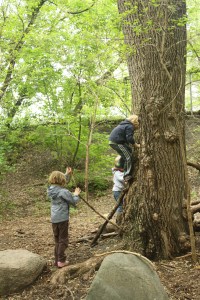
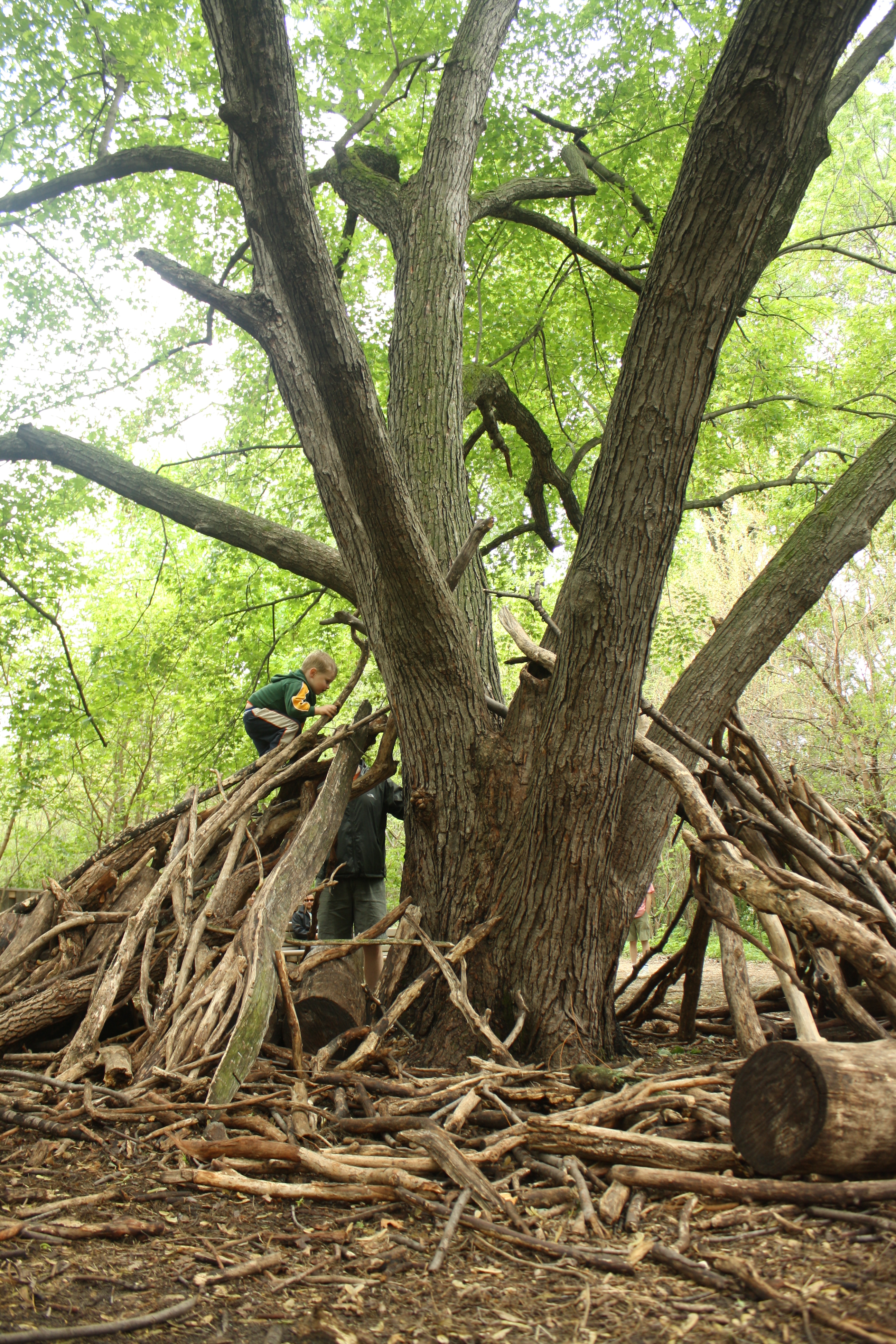
No slides, no structures. Just one big fenced in area with two really big trees. No man-made objects. Just sticks, small logs, trees, rocks, stones, slices of trunks of trees.

The kids were in HEAVEN!

Climbing Trees.

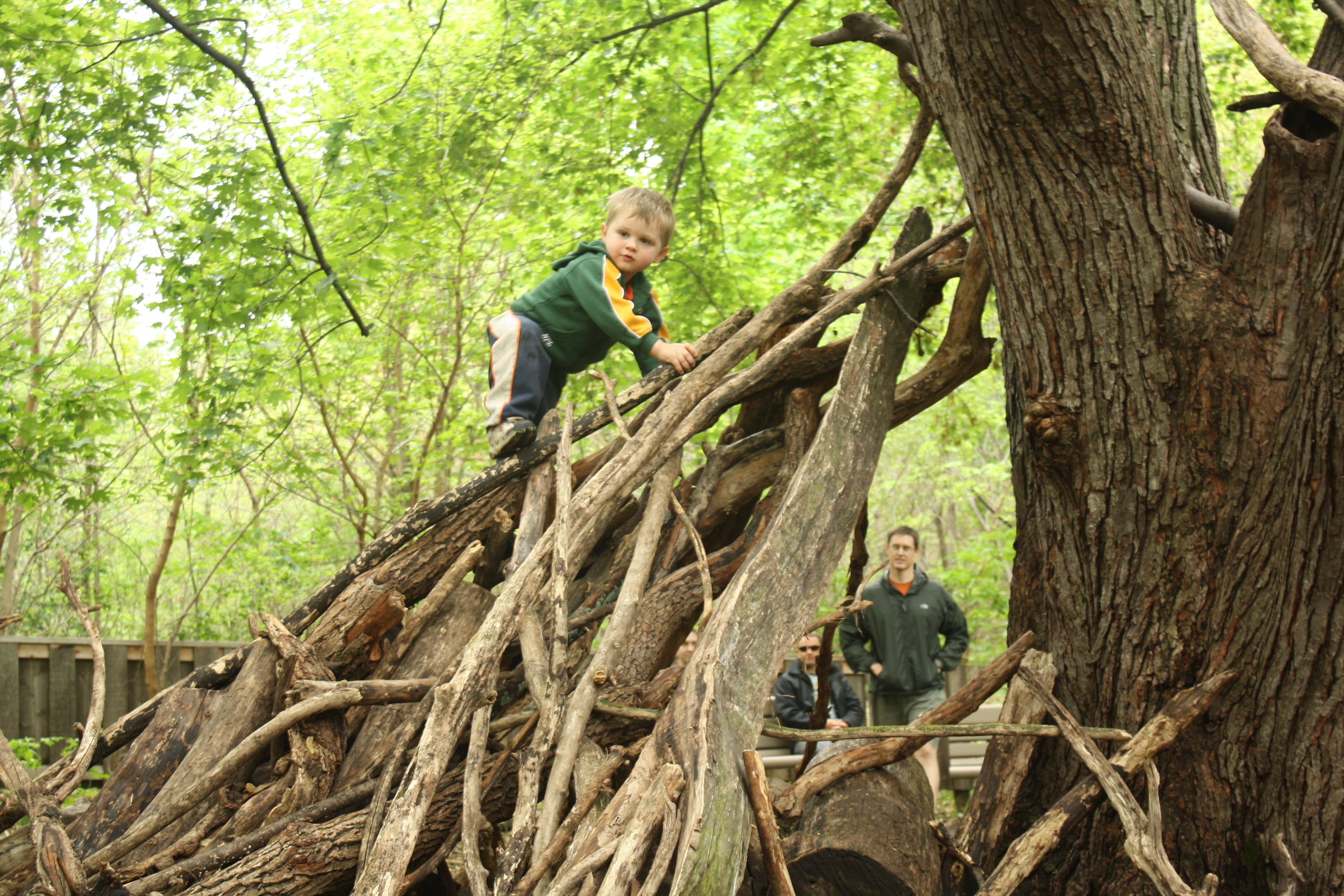
Building Forts.

 Image

Image

Image

Scaling high peaks.


Or staying close to the ground on rocks just her size.


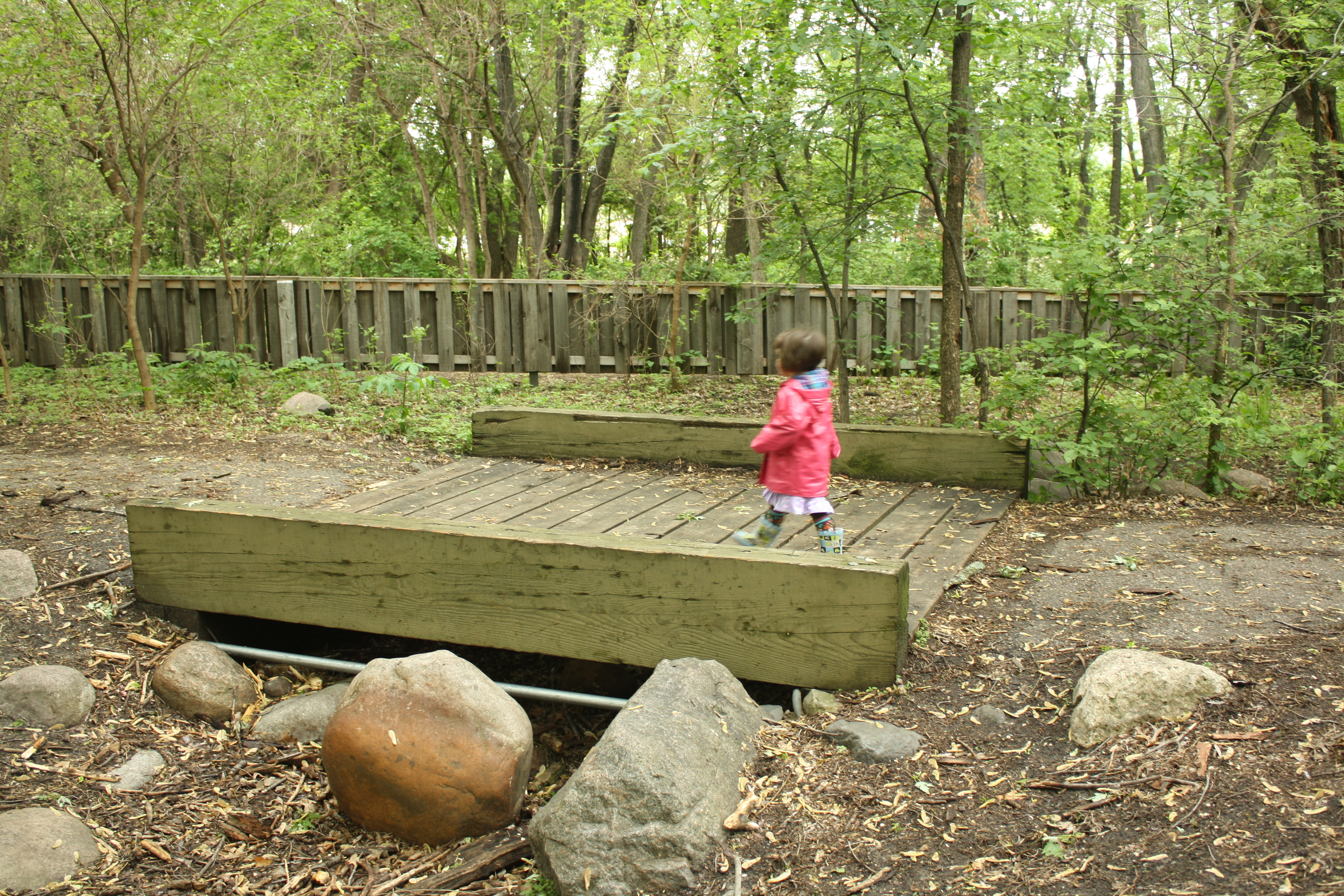
The bridge was also a lot of fun.

And when we tired of that, we went for a walk on the paths listening for crickets, frogs and birds.

Into the woods,


where the ferns were exploding and so were the smiles!


Around the marshlands and lakes we went.

It was like a fairy tale. Just gorgeous!

(Our younger companion enjoyed nature from her stroller.)

But later fell asleep!

If you live in Minnesota, check out the Wood Lakes Nature Center. It’s a treat!

RELATED POSTS:

Living “Hands Free” and Technology Free for Your Children
Kids Removed from Nature
Advocating for Your Child to Remain Electronics Free

May 19th ‘National Kids To Parks Day’

From http://www.childrenandnature.org/news/detail/npts_national_kids_to_parks_day_to_take_place_saturday_may_19_2012/

“National Park Trust reports 50,000 registrants in 45 states have pledged to participate, 219 cities and towns have passed resolutions and the governors of Colorado, Washington and West Virginia have signed proclamations declaring May 19 National Kids to Parks Day.  Families can join the fun and sign up online at NPT’s web site www.kidstoparks.org.”

“Recognizing that young people spend far too much time indoors and far too little time appreciating and preserving America’s magnificent national, state and local parks – the National Park Trust is mobilizing kids across the country for a nationwide park play-in.  The new website, www.kidstoparks.org, is interactive with links to park activities nationwide and provides a toolkit of ideas and activities for children, families and educators.”

Hmm…Might just have to think something special up for that day!

Beyond the Playground

Yesterday I had to take the day off from work because my child’s daycare had school conferences. On conference day her classroom closes completely and I’m forced to take the day off to watch my daughter. On the one hand, this is seen as an inconvenience. I can’t go to work; there are things that need to be done, etc., etc.

Obviously the flip side is that I have the opportunity for a full day of quality time with my child.

Fortunately for us, it was a gorgeous day out and we spent the whole morning outside. After the morning conference and a bike ride to breakfast, we ended up at a playground. As most children do, my daughter loves playgrounds.

“Momma. First eat. Then pwaygwond. Yes?”

“Yes, honey. First we’ll eat and then we’ll go to the playground.” For the hundredth time.

Finally we got to the playground. For the first time in months, perhaps even years, I was able to sit and just enjoy the out-of-doors while my daughter played. She was in heaven digging in the sand, swinging on the swings, watching the other children. I was in heaven doing nothing.

After a long time of enjoying this peaceful bliss of nothingness, I started thinking. What other opportunities are there for her out here? What can I show her in the world that goes beyond the man-made play structure? It was then that I noticed the field of dandelions. I suggested that she and I go look at the flowers. It was hard to tear her away from all the fun she’d been having, but she obliged and went out to explore.

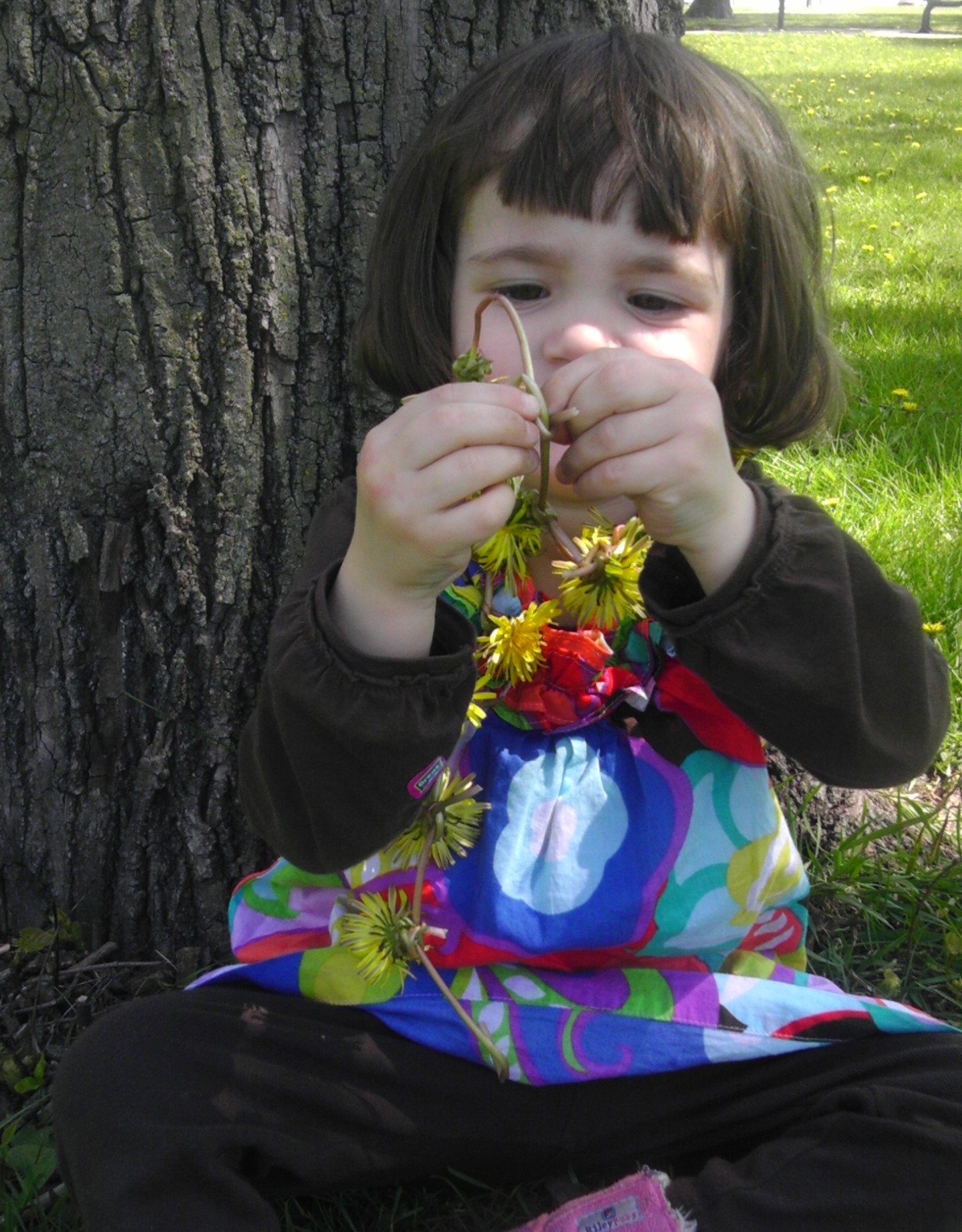
We went over to the field of dandelions and sat to look at them. I had a flashback to some of my earliest and most delightful memories. I used to love to sit in a field of dandelions and just pick them. When I got older I would sit with my other little girl friends and we would make long chains of dandelions and turn them into necklaces.

I did the same now. I began to weave together a necklace of dandelions for my sweet little girl. I encouraged her to find me the “really long ones” and to bring them to me. She did. She would look really hard, would pluck them and would say, “Really long, mama, this one really long!”

It’s a simple story but one filled with beauty and delight, in the wonder and curiosity of exploring something new.

After making the necklace I tried to get a picture of her looking up at me but I just couldn’t get the picture. “Please, honey, look up at mama.”

“Why can’t I get a good shot?” I’d ask myself. “Can’t she just look up for just one second?”

Through the lens all I could see was that she wasn’t looking at me.

As I look back at the pictures now, I see now why she wasn’t looking at me. It wasn’t that she wasn’t looking at me it was that she was too busy.

She was actively engaged in this new wonder of the world.

She was looking down at the wonderful chain of flowers falling around her neck.

She was in her own world, in a place beyond the playground.

Good-bye Three Little Birds

 Image 

This is a short tribute to an in-home daycare/childcare center/preschool that my child never attended. But, oh, did I want her to go! Its last day is April 26th – they are closing due to changes in their family and for financial reasons.

The reason I want to pay tribute to them is because in my eyes, they are the ideal model for what a childcare center or preschool should be like. The children are outside as much as possible, they learned about the earth and about nature, they experienced the world hands on and with wild abandon. The husband-wife team went all out to make every day a complete, full body experience for the children they had in their care and you could clearly see the children were loving every minute of it.

The couple write about their inspiration for opening such as a center. It’s a topic close to my heart: the loss of nature in children’s lives. This couple brought nature into the children’s lives in full force: mud baths, walks in the woods, eating meals outside. Take a look for yourself.

Good-bye Three Little Birds. I wish my daughter had gotten to know you better!

http://threelittlebirdscc.blogspot.com/p/about-us.html

http://3lbonourminds.blogspot.com/

http://www.threelittlebirdscommunity.com/1/post/2012/04/saying-goodbye.html

Picture

And I Don’t Believe in Boredom

I grew up in a family where uttering the words “I’m bored” were akin to taking the Lord’s name in vain. No child with as many toys as my siblings and I had any reason to be bored. We had games, blocks, dolls, toys and, better yet, books. We had a split level house with a family room, a backyard with a swing and a court full of playmates. I had an older brother and a sister two years younger than me—the perfect playmates. Most importantly I had my imagination. What possible reason could I have to be bored?

My mother grew up in the 50s in rural Kansas. Her family did not have much money and likely had many fewer toys to play with than we did. In addition, my mother was afflicted with polio at the age of eleven and was sent away for treatment over a day’s drive away from her family. She stayed in a hospital for 6 months with her family only visiting on weekends. If anyone knew what boredom felt like, it was my mother.

In the 50s there were no televisions in hospitals rooms. There were no ipods, ipads, smart phones, laptops, game boys or any of the other handheld electronic devices that the children of this era often sport. The greatest forms of entertainment were books, other children and their imagination. My mother learned the valuable lesson of how to entertain herself at a very early age.

From time to time I read about toddlers “getting bored easily” or I hear parents saying “Well, we went to that play area but he got bored really quickly.” When I read or hear those words, I cringe. Now don’t get me wrong, I have a toddler– a very active, easily distracted, slightly hyperactive two and a half year old. I understand that toddlers do not have long attention spans; however, I still do not mark up impatience or lack of interest to boredom. I mark it up to a lack of creativity on the parent’s part.

This evening I gave my toddler a bath. The twenty-five plus toys that I have bought and assembled for her over the past two years no longer seem to be of interest to her. If she is bathing by herself she will usually last for about one minute before announcing “I want ouuutttt…out momma…..out….!!!” Usually this means, I want to be with you mom. If she is bathing with her same age cousin, the bath can last for hours as she plays, dumps water on his head repeatedly, and “washes” his hair. If she is by herself and the bath has no longer become of interest to her it’s because I have failed to make it a place that challenges or intrigues her developmentally or I have failed to offer something even more important, my attention.

My daughter is not bored with the bathtub. She just needs the company of her mother or a fresh perspective.

Tonight when I put my toddler in the bathtub I took two of the toys that she’s had available to her for months and I sat down with her to show her how to make them work and to play with her for a few minutes. One was a cup and the other a cup with a wheel that spins when water runs through. Pouring the water back and forth between these two cups kept her occupied for the next ten minutes. Taking two minutes out of my evening bedtime activities opened up a world of entertainment and excitement for her. She was not bored with the bathtub – she just needed some direction as to how to entertain herself – and that is because she is two. These are the skills that we teach our children.

Adults in this era are accustomed to instant gratification. Hit a button and the computer comes on. Instant entertainment. Drive by a building with a window and viola! Instant dinner. Give your child an iphone and show them a video. Instant babysitter!

Before I had my daughter I was in a relationship with a man who was a single parent to a five year old and an eight year old. If the wait at the restaurant was longer than two minutes he insisted we leave because his children would not be able to handle it. A five minute wait for food was accompanied by a bag of toys to keep them occupied. As soon as the meal was over, he would hunt down the waiter or waitress because the kids were bored. To put it in context, this man was addicted to his Blackberry.

Regardless of whether those children were bored or not, by being constantly entertained or removed from environments in which they might have to invent ways to entertain themselves, they were being deprived of two valuable lessons: 1. We go to restaurants to socialize with the people we love, not to be entertained constantly. 2. If you want to engage in an activity while you are waiting for something, you can use your imagination to find something to keep you interested and stimulated.

In addition to being deprived of valuable lessons they were unfortunately learning a lesson that is all too common in this day and age: If there is a moment of silence or a moment of inactivity that there must be something to fill up that time.

For many parents, electronic toys have become a parent’s extension of their own need for instant entertainment gratification onto their children. Children are not being taught how to entertain themselves and how to socialize with other people, they are being taught that if they are lacking in something that is of interest they should either leave the environment or hit a button and turn on an electronic device.

Last week I was in an ice cream café and my young two year old went up to a three or four year old boy who was busying himself with his parents’ phone. My daughter was exploring her environment, socializing and finding ways to occupy herself that were pleasing to her. The boy was lost in his parents cell phone…well, lost in a non-human interaction and missing the challenge of learning to entertain himself. Refreshingly, the parents took the phone from the boy and encouraged him to socialize with my daughter. In my opinion, he should never have had the phone in the first place. Is ice cream and your parents company not entertainment enough?!

Using electronic devices to silence our children is crippling our children’s natural curiosity of the world and of their ability to socialize with others. As parents we need to be aware of this before we end up with a generation of children who are constantly reliant on some external source for entertainment. We are raising a generation of children who need it and need it now. We may be raising a generation of children who do not socialize well and who will one day be raising the next generation.

The change must begin now.

(Please leave comments in the comments section to let me know what YOU think!)

Christina